The IAEA today released its annual nuclear power status data for 2019 collected by the Power Reactor Information System (PRIS), the world’s most comprehensive database on nuclear power. PRIS, developed and maintained by the IAEA for over five decades, contains authoritative historical and current quantitative information on nuclear power reactors in operation and under construction or in decommissioning phase.
At the end of December 2019, the global operating nuclear power capacity was 392.1 GW(e), comprising 443 operational nuclear power reactors in 30 countries. Overall, nuclear power capacity since 2011 has shown a gradual growth trend, including some 23.2 GW(e) of new capacity added by the connection of new units to the grid or upgrades to existing reactors.
In 2019, though, total global capacity decreased by some 4.5 GW(e) compared with 2018, a figure that reflects Japan’s decision to permanently shut down five reactors that had not generated electricity since 2011. At the end of 2019, over 57.4 GW(e) of capacity (54 reactors) was under construction in 19 countries, including four that are building their first nuclear reactor. Near and long-term capacity growth prospects are centred in Asia, which at the end of 2019 reported some 36.5 GW(e) of nuclear power capacity (35 reactors) under construction.
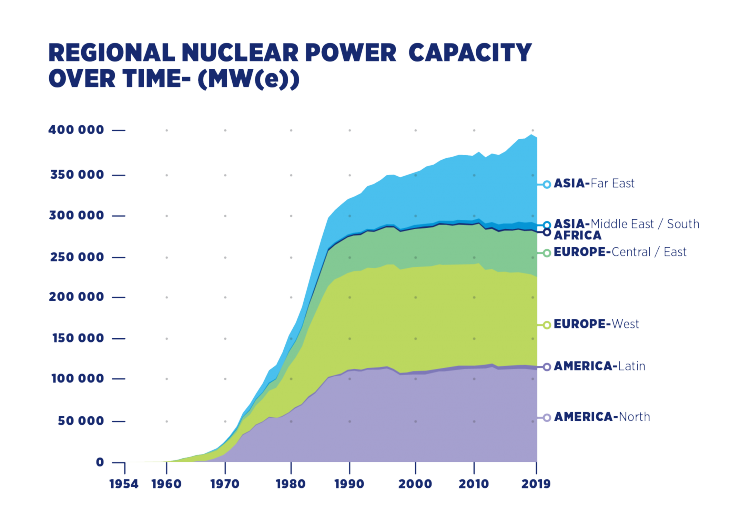
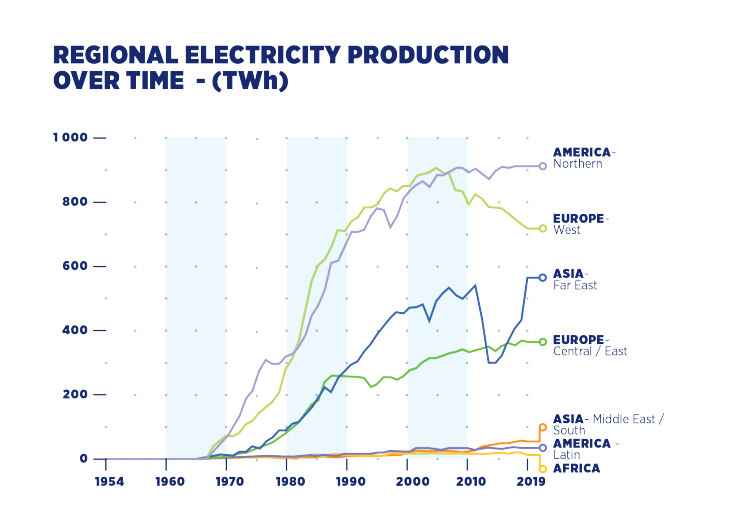
Throughout 2019, nuclear power supplied 2586.2 TWh1/ of emission-free, low-carbon baseload electricity. That accounted for about 10% of total global electricity generation and nearly a third of the world’s low-carbon electricity production. Nuclear generation has continuously grown over the past years, expanding by more than 9% since 2012.
Capacity added and units connected to the grid. In 2019, six new pressurized water reactors (PWR) were connected to the grid, resulting in an additional 5174 MW(e) of nuclear power capacity. Over 77% of this new capacity was added in Asia and included two reactor units in China at Taishan-2 (1660 MW(e)) and Yangjiang-6 (1000 MW(e)), and one reactor unit in the South Korea at Shin-Kori-4 (1340 MW(e)). In addition, three nuclear power reactor units with a total capacity of 1174 MW(e) were connected to grid in Russia, including Novovoronezh 2-2 (1114 MW(e)) and the world’s first commercial floating nuclear power plant ‘Akademik Lomonosov’ which comprises two units of 30MW(e) each.
New build construction. As of 31 December 2019, 54 reactors were under construction in 19 countries with a total of capacity of 57441 MW(e). Installed nuclear power capacity under construction has largely remained steady in recent years, except for continuous growth in Asia, where a total of 55067 MW(e) operational capacity (61 reactors) has been connected to the grid since 2005. In 2019, the construction of five PWR reactors began, with two in China (Zhangzhou-1 (1126 MW(e)) and Taipingling-1 (1116 MW(e)) and one each in Iran (Bushehr-2 (974 MW(e)), Russia (Kursk 2-2 (1175 MW(e)) and the United Kingdom (Hinkley Point C-2 (1630 MW(e)).
Capacity removed and permanent shutdowns. Thirteen reactors with a total capacity of 10196 MW(e) were permanently shut down globally. Some 47% of the capacity reduction resulting from permanent shutdowns came from five reactors in Japan that had been idle since 2011: Genkai-2 (529 MW(e)), Fukushima-Daini-1 (1067 MW(e)), Fukushima-Daini-2 (1067 MW(e)), Fukushima-Daini-3 (1067 MW(e)) and Fukushima-Daini-4 (1067 MW(e)). Other permanently shut down reactors in 2019 include Chinshan-2 (604 MW(e)) in Taiwan, China; Wolsong-1 (661 MW(e)) in the Republic of Korea; Philippsburg-2 (1402 MW(e)) in Germany; Ringhals-2 (852 MW(e)) in Sweden; Muehleberg (373 MW(e)) in Switzerland; Bilibino-1 (11 MW(e)) in Russia; and Pilgrim-1 (677 MW(e)) and Three Mile Island-1 (819 MW(e)) in the United States of America.
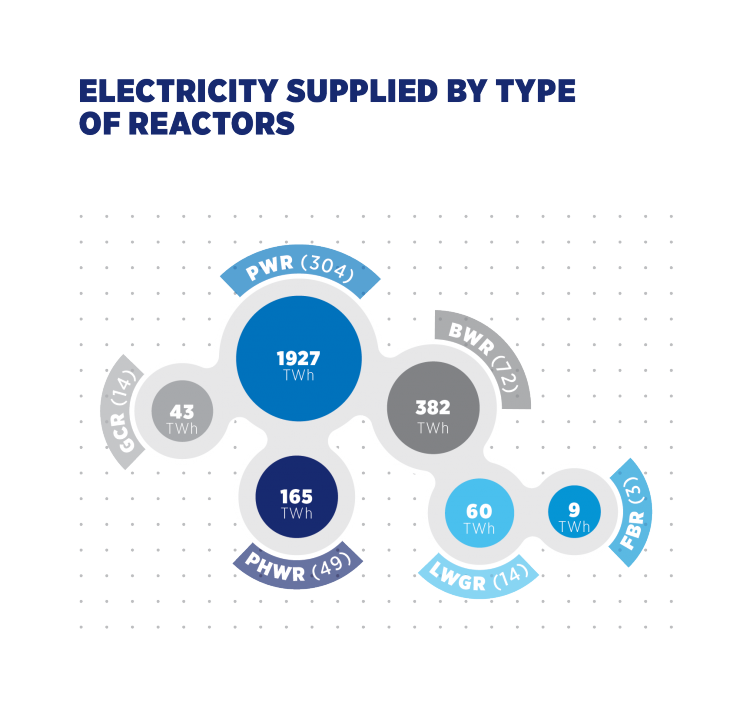
Operational reactor types. Some 89.2% of the operational nuclear power capacity was comprised of light water moderated and cooled reactor types; 6.1% were heavy water moderated and cooled reactor types; 2.4% were light water cooled and graphite moderated reactor types, while the remaining 2.0% were gas cooled reactor types. Three reactors were liquid metal cooled fast reactors.
Non-electric applications. In 2019, 71 nuclear power reactors in 11 countries utilized 2146.7 gigawatt-hours (GWh) of electrical equivalent heat to support non-electric applications of nuclear energy such as for district heating, process heat supply or desalination purposes. About 88% of the heat was supplied by 57 reactors in Europe and 12% by 14 reactors in Asia. Further, 10 reactors supported desalination (using 48.0 GWh), 56 reactors supported district heating (1870.6 GWh) and 32 reactors supported industrial heat applications (1248.0 GWh).
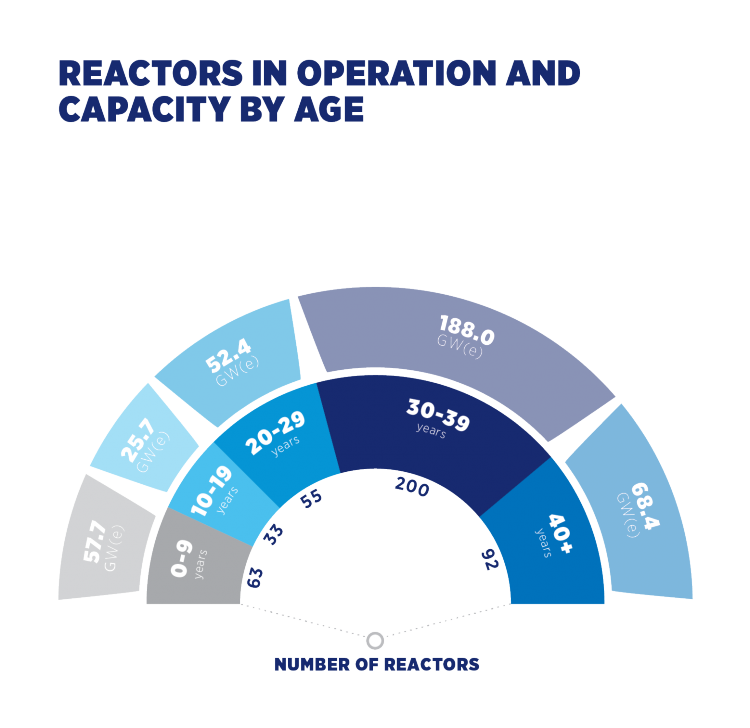
Operational lifetime. At the end of the 2019, the worldwide cumulative reactor operating experience amounted to over 18,329 reactor years of experience, with a total capacity of 474.2 GW(e) and 629 reactors across 33 countries. Of these reactors, 186 reactors with total capacity of 82.1 GW(e) are permanently shut down. 256.3 GW(e) of net capacity, representing more than 65% of power reactors, had been in operation for over 30 years. Of this, reactors in service for over 40 years accounted for 17% of global capacity, while 0.5% have been operating for over 50 years. These reactors, all connected to grid in 1969, include two reactors in India (Tarapur-1, Tarapur-2), one reactor in Switzerland (Beznau-1) and two reactors in the United States (Nine Mile Point-1 and Ginna). Long term operation and ageing management programmes are being implemented for an increasing number of nuclear power reactors globally to ensure continued safe and sustainable operations.
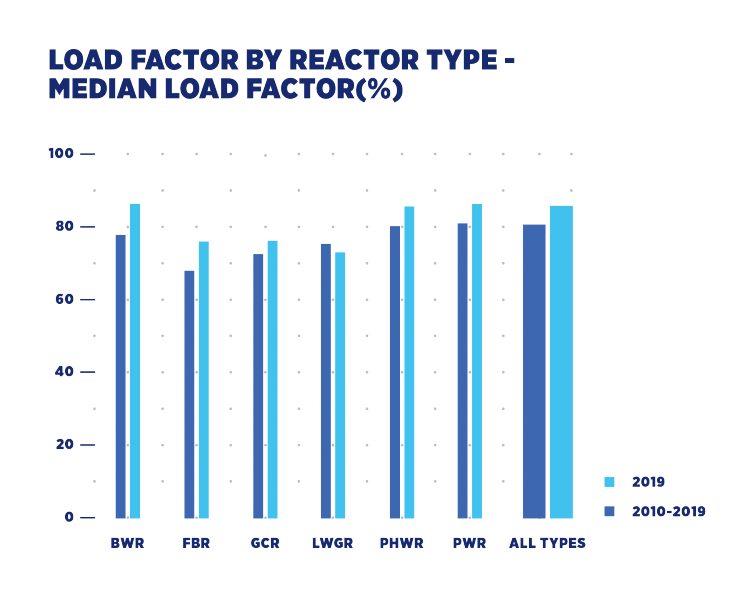
Unit performance. Even as the nuclear power fleet ages, operational nuclear power plants continue to demonstrate high levels of overall reliability and performance. The Load Factor, also referred to as the Capacity Factor, reflects the actual energy utilization of a reactor unit compared to its reference power output; a high load or capacity factor indicates good operational performance. In 2019, the global median capacity factor was 85.9 %, in line with the load factor in recent years.
Another indicator measuring the performance of nuclear reactors is the Energy Availability Factor (EAF), which refers to the ratio of energy that the available capacity could have produced during a specific period of time to the energy that the reference unit power (RUP) could have produced. In 2019, the weighted average EAF was just 77%, where half of nuclear reactors also operated with an EAF above 87%.
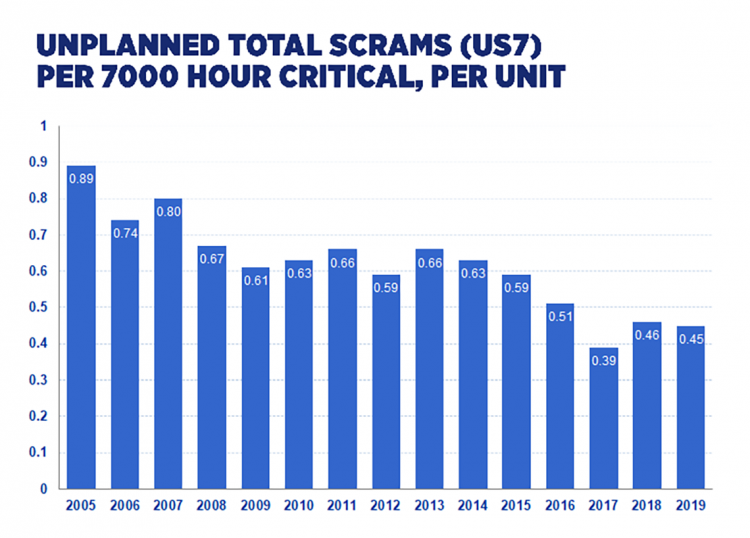
The reliability and safety of nuclear power reactors have continued to improve over time. The figures below demonstrate a gradual reduction of the number of unplanned manual and automatic scrams (US7) or shutdowns per 7000 hours (approximately one year) of operation per unit since 2005. The reduction in the number of unplanned scrams indicator is attributed to continued successful plant operations and maintenance management.
For more nuclear power statistical data and related graphics, which uses charts and data visualization to convey historical global trends in nuclear power. PRIS has been developed and maintained by the IAEA since 1969, based on information provided by counterparts in countries worldwide.