The small town of Cordova, Alaska, is located 150 miles southeast of Anchorage, near the picturesque head of the Orca Inlet on the Prince William Sound, at the mouth of the Copper River. It is renowned for its Copper River king and red salmon. Every year, the town transforms into a seafood and fishing powerhouse for five months, as one of the most expansive, rich locations for commercial fishing in the U.S.
Cordova’s economy is reliant on its commercial fishing and processing, and more than half of all households are involved in the industry. The fish caught at the mouth of the Copper River usually sell for high prices at fine dining restaurants and markets around the world. For example, last year Copper River king salmon sold for $75 per pound at Seattle’s Pike Place Market, which draws large numbers of tourists to see its famous fish tossers. As the peak months approach, the promise of harvest calls most of the fishermen and fisherwomen to the river in a migration that culminates at the Copper just before the salmon arrive for the fishing season.
With Alaska’s largest fishing fleet, commercial fishing also drives Cordova’s energy needs. As the fishing season begins in the spring, Cordova’s population doubles; traffic creates bottlenecks throughout town and the line for the boat launch stretches long. As several hundred seasonal workers arrive and fish processing plants ramp up for the season, the town experiences its peak electricity demands, nearly triple its need from the winter peak.

Meeting these increased demands comes with many challenges most towns don’t experience. Cordova is a remote community—one of the 165 Alaskan communities that can be reached only by plane or boat—and is not connected to outside electric transmission lines or highways. The extreme climate also poses challenges. Over the past five years, Cordova has experienced two earthquakes of more than 7.0 magnitude, a large volcanic eruption, superstorms with winds topping 100 miles per hour, including snowstorms dumping feet of heavy, wet snow.

The extreme environment, remoteness of the community, variability of fish returns and open fishing periods, and the high peak electrical demands of the fishing season translate into highly variable and uneconomical energy consumption for the small town. The high costs were driven by diesel fuel consumption required to meet peak demands. Cordova needed to find a way to become more energy efficient and cost effective on their independent grid.
How Cordova Ended its Dependence on Fossil Fuels
In 1989, the Exxon Valdez oil spill, which spilled 11 million gallons of crude oil into Alaska’s Prince William Sound (the worst oil spill in U.S. history until the Deepwater Horizon oil spill in 2010), caused severe ecological and economic damage to Cordova and across the region. Due to its remote location, disaster response efforts were not able to fully meet the needs of the community, and the town ultimately had to rebuild its economic base and infrastructure. In all the stress of rebuilding, this disaster ultimately provided new energy opportunities.
Cordova Electric Cooperative (CEC) decided it was time to move away from using diesel generators and diesel fuel, which had to be imported by ship and was costly and environmentally hazardous. In other words, the town needed to be energy independent.
In order to kickstart its energy independence, CEC established a hybrid microgrid, which would enable the adoption of renewable power from a variety of sources, including two new hydroelectric projects.
These hydroelectric projects cover Cordova’s baseload with two 3-MW run-of-river hydro generators at CEC’s Power Creek facility, along with a 300-kW and two 500-kW turbine, 1.25-MW run-of-river hydro facility at Humpback Creek. When needed, CEC supplements the hydro power with output from the Orca diesel generation plant, where the main control center is located. Two 1-MW diesel gensets, along with a 2.4-MW, a 2.6-MW, and a 3.7-MW diesel genset, are used to support the peak loads in a departure from hydro-only operation. The gensets are also powered up during the winter when the rivers freeze and water flows decline.
In hydro-only mode, operators control the grid frequency by adjusting the angle of fast-acting water deflectors at Power Creek. These divert part of the water stream away from the turbines to modulate their power output, thereby maintaining grid stability. This is like the concept of spinning reserve in a conventional grid, and CEC typically deflects about 750 kW of capacity to support sudden load increases.
Hydropower is great for cutting costs, averaging about $0.06/kWh, while diesel generation costs can be as much as 10 times higher, depending on highly variable fuel prices. Hydropower alone meets as much as 78% of annual demand. But while hydropower can provide almost all of Cordova’s power in the summer, and a good portion of its power in the winter, there is no way to store any excess, so deflected water simply flows down the river and the renewable energy is lost.
Come spring, runoff provides plenty of water to power Cordova. But then the fishing season kicks off, and CEC transitions from hydro-only to a combination of hydro-diesel generation. When the hydro reserve drops below 750 kW, a 1-MW diesel genset starts. Because the diesel must run at a minimum output of 400 kW, this increases the amount of hydro that ends up spilled; the just-under 750 kW needed for spinning reserve plus the 400 kW the diesel displaces as it comes online. During this transition period, CEC wastes more than 1 MW of water power while burning expensive diesel fuel at the same time. Depending on load patterns, the changeover can last from a few hours to several days—and the longer the changeover takes, the more expensive it becomes.
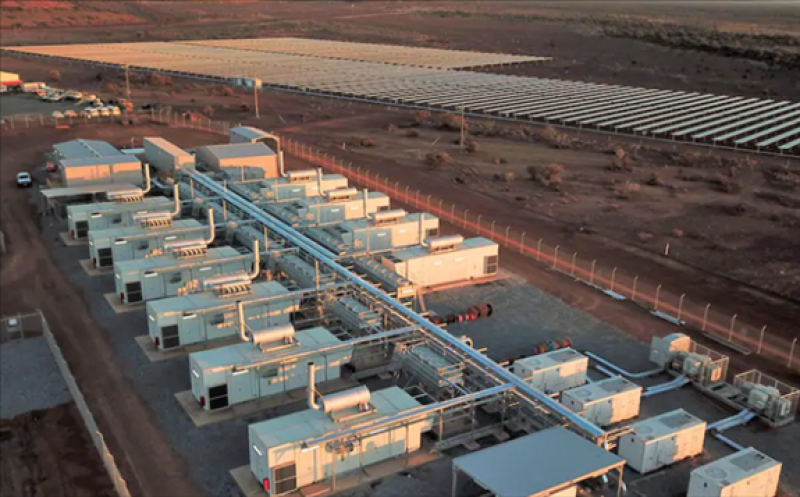
CEC needed a solution to this problem. The team recognized that a grid-scale energy storage system (ESS) would enable it to make the most of its renewable energy and control costs while reducing reliance on imported diesel. As a result, CEC turned to Saft, which specializes in advance-technology battery solutions, to develop a lithium-ion-based ESS solution rated at 1 MW with 1 MWh of energy storage capacity. To help CEC regulate the electrical system and maximize the use of locally produced hydroelectric power, they identified a preferred package solution, which included a Hitachi ABB Power Grids power converter and battery container located at the central substation in the CEC grid.
CEC partnered with Hitachi ABB Power Grids in October 2018 for its power conversion and advanced control technology to create a battery energy storage system (BESS), which came online in 2019. The BESS provides additional spinning reserve, which allows CEC to take full advantage of the hydropower generation potential. The Hitachi ABB Power Grids system is coupled with lithium-ion batteries from Saft to replace diesel or hydro power for grid frequency stabilization to balance system loads. The fully automatic Hitachi ABB Power Grids system is the main CEC microgrid frequency forming source.

Because the BESS provides what is essentially an additional spinning reserve, it enables CEC to open its deflectors fully and avoid spilling hydro generation capacity. Rather than starting up the diesel generators when flow past the deflectors drops below 750 kW, the ESS operating principle is specified to pick up the load to inject and absorb power to maintain grid frequency. When the state of charge drops below 30%, CEC’s automated dispatch system will start up the diesel genset, which then can operate at its minimum output of 400 kW to service demand and recharge the battery at the same time. If the state of change reaches 70% and the net load remains low, the diesel will shut down and the BESS will regulate frequency and also discharge to help meet full system demand. On the flip side, if the net load increases above 400 kW, the diesel will take over frequency management and the BESS will be recharged and remain in standby mode only if there is no excess hydropower going to waste.
With the high performance of the BESS, CEC expects to save between 40,000 and 50,000 gallons of diesel fuel per year. This provides the opportunity to increase renewable energy use and save even more gallons of diesel fuel. CEC has also added an electric boiler to keep its increasingly idle diesel generators heated to 135F for immediate duty, which replaced a fuel-oiled boiler that used to provide this service. With the additional 750 kW of hydro capacity, CEC has been able to displace thousands of gallons of diesel fuel through this boiler in addition to grid savings. As a result, CEC has been able to reduce its dependence on diesel and move closer to its goals for sustainability, reliability and long-term management of Cordova’s electrical system. Now, CEC can rely on operational and performance guarantees as well as outsource the need for specialist engineering integration and optimization.
How Cordova Selected its Microgrid
Because Cordova has no larger electric grid to connect to if CEC’s system goes down, grid resilience is critical. The remoteness of the community also made installing storage systems much more of a logistical challenge. CEC needed to select partners with well-established track records and long histories of success. A major factor in selecting solutions from Hitachi ABB Power Grids is that these solutions have been installed on a commercial basis elsewhere in Alaska, demonstrating that the technology could withstand the tough Alaskan environment. This gave CEC confidence that these solutions would work long-term for its needs.
When purchasing an energy storage system, it is important to choose carefully. Removing, recycling, and replacing a full battery set can represent an additional 60% on top of the initial purchase price of a package. In addition, factory warranties and annual maintenance contracts can be costly, especially for remote communities like Cordova.

CEC wanted to deliver optimum value for its community, so it needed to choose solutions based on research and data. The first step was to perform system modeling, which was supported by Dr. Imre Gyuk, director of energy storage research at the U.S. Department of Energy, who commissioned Sandia National Laboratories and the Alaska Center for Energy and Power at the University of Alaska-Fairbanks. To further support the modeling and estimate fuel savings, CEC referenced a normalized year of detailed load and hydro data from its multiyear database. Additionally, Saft ran detailed simulations based on the new control philosophy to validate the fuel savings and calculate battery aging. This became the starting point to specify the ESS and provided a share of the costs to support the integration.
During the modeling process, CEC learned several important aspects of energy storage and battery technology, particularly the impact the operating regime can have on battery aging. For example, with the right battery chemistry, the calendar and operational aging of lithium-ion batteries can be reduced to a capacity loss of less than 3% per year. This is accompanied by a slight loss in roundtrip efficiency, although the power capability remains almost constant. However, lithium-ion batteries can age catastrophically if used aggressively to the point of abuse. Therefore, the choice of operating setpoints is critical for battery life and, consequently, an optimized return on investment.
In addition, energy storage capacity over life was an important factor for CEC to consider. Deep cycling causes a more rapid loss of capacity. For example, if an ESS rated at 1 MW and 1 MWh is completely charged and discharged from 100% to 0% state of change, it will deliver about 5,000 cycles, equivalent to 5 GWh of total energy delivery. However, if it delivers small charge and discharge cycles of about 5%, the same battery can deliver 1 million 500-kWh cycles, or 500 GWh, over its life.
As an ESS for an application grows in size, its lifetime GWh throughput and final kWh capacity also increases with its purchase cost. It is important to balance the priorities of total lifetime cost of ownership. Frequency control operation requires many small charge and discharge cycles, which can take place at the same time as bulk charging or discharging. The trick is to optimize the setpoints for the larger state of change swings so battery life is preserved while also maximizing savings in diesel fuel.
While lead times can be quite short for energy storage projects, it is worth taking time to properly specify the ESS, power conversion equipment and communications interface. Based on its modeling, CEC estimated annual costs of about $170,000 for each of the first 10 years, as the cost of hardware, design and integration, labor, and other costs were amortized. Calculations forecast fuel savings would be in the range of 35,000 gallons per year. When combined with other savings, including a reduction in maintenance for the diesel gensets, annual operating savings were expected to be $150,000.
While estimated costs are higher than savings initially, the community benefits on a holistic basis. Cordova will become more resilient and less reliant on fuel deliveries from outside the town. City officials also are currently looking at options to implement bulk hydro storage as well as pumped hydro storage, with the goal of meeting 100% of its needs with local hydropower. Thus, the ESS is an important step in CEC progressing toward its own smart grid and smart city future. Thus far, the fuel savings have exceeded expectations, and additional fuel savings have been derived from the electric boiler station heat to the diesel plant, and the system has performed well, resulting in a projected net costs savings from the BESS.
The energy industry is still working to fully design and bolster grid resiliency. For remote communities like Cordova, with extreme environments and huge peaks in demand, there was no time to wait for a clear and final solution. The ultimate vision is to have a self-sufficient, sustainable electrical system used not only for traditional electricity generation and sales, but for supporting beneficial electrification in the form of home heating, charging electric vehicles, and someday fishing boats and aircraft. While there is still a long way to go, the ESS project represents a major milestone in grid optimization and resilience for CEC and the town of Cordova on the path to making their vision a reality.