In 2018, Siemens, Seadrill, and Northern Ocean took an important step toward solving this problem by implementing the world's first lithium-ion battery solution on the West Mira drilling rig in the North Sea. West Mira is a sixth-generation, ultra-deep-water (10,000-ft) semi-submersible that will operate in the Nova Field, approximately 120 km (75 miles) northwest of Bergen, Norway. It will be the world's first hybrid rig to operate a low-emissions hybrid (diesel-electric) power plant using lithium-ion storage technology, with DNV-GL Power Notation.
The concept of using lithium-ion energy storage solutions in both all-electric and hybrid power systems is not new. However, it has not been until recent years that large megawatt-hour capacity battery solutions have been commercialized for use in marine applications. This is primarily because of the numerous technical hurdles that have had to be addressed, including high capital cost, limited battery range, lifespan and reliability, and so forth. Safety has also been a critically important factor.
Because lithium-ion batteries combine high energy materials with flammable electrolytes, any damage to the separator as a result of mechanic stress or high temperature will lead to an internal short-circuit. This causes the electrolyte inside the cell to begin evaporating, resulting in an increase in internal pressure until the electrolyte vapor is eventually released, either through a relief valve or by the bursting of the cell shell. Without protective measures in place, an explosive gas-air mixture is created and if heating is not ceased, thermal runaway takes place.
Thermal runaway poses a serious safety concern for any facility that uses lithium-ion energy storage. However, in marine vessels and offshore facilities, the risk is magnified as there are limited options for personnel to be evacuated from the area where danger exists. Also, an explosion could cause catastrophic damage to the structure.
Additionally, in oil and gas operations, combustible fuels are present, which increase the risk of fire spreading. For this reason, lithium-ion energy storage solutions used in marine environments must incorporate fail-proof design measures to ensure safety.
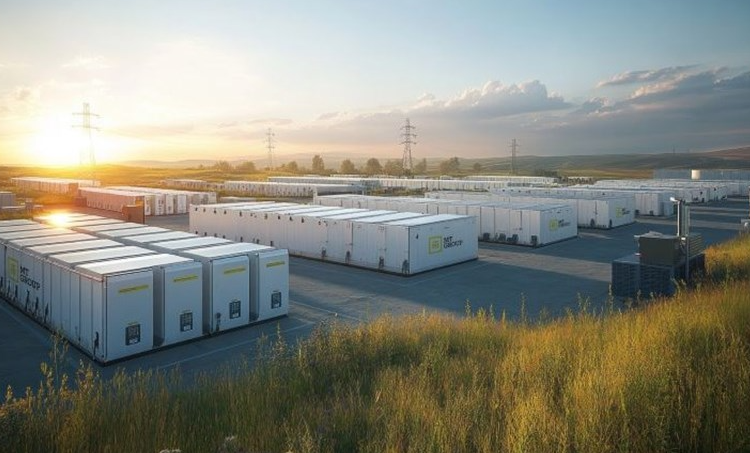
This was the primary design objective of the battery solution (formerly named Blue Vault) used for the West Mira drilling rig. Individual cells in battery packs are equipped with propagation protection to prevent large-scale thermal runaway. Gases produced as a result of the thermal event are ducted through the cubicle that holds the battery modules. Any thermal runaway event that occurs within the system is isolated on the cell level. A freshwater cooling system regulates the temperature in the batteries.
The cooling system is designed to work as a passive safety layer to ensure that a faulty battery cell will not propagate to any neighboring battery cells. It also keeps the battery temperature stable and helps to extend its lifespan. The latter is influenced by a variety of factors, including ambient temperature, number of cycles, depth of cycles, and so forth. The typical life expectancy of the battery system is around 10 years.
The West Mira drilling rig was also the first rig in operation to be awarded the DNV GL Battery (Power) Class Notation, meaning the batteries can be part of the Dynamic Positioning (DP) power calculation. In a press release issued by DNV GL, Geir Fuglerud, director of offshore classification at DNV GL, said: "With the Battery (Power) Class Notation, we are helping our customers in the offshore industry take advantage of new technologies for safer, more energy-efficient and environmentally friendly operations."
Additionally, individual battery cells are equipped with WiFi to enable communication with central control. This provides transparency regarding how the different modules are operating and allows for immediate response when one cell is not functioning properly.
Each battery module is highly digitalized and contains roughly 100 monitoring points. This means that in a megawatt-hour battery system, like the one on West Mira, there are as many as 15,000 points where data is being collected. As a result, system operators are provided with a high degree of visibility regarding the performance of the battery system. Data collection also enables the use of advanced digital tools, such as machine learning and artificial intelligence (AI), to analyze patterns, identify anomalies, and even predict potential problems before they occur.
Data collection on a granular level also has long-term implications for the development of battery technologies. As more and more data is gathered and analyzed, manufacturers and users can begin to better understand better what variables impact battery performance and lifespan and how their design can be improved.
Benefits of energy storage system (ESS) in offshore oil and gas facilities
The incorporation of energy storage in an offshore facility or vessel power plant enables a wide range of new capabilities that can lead to higher efficiency and lower emissions.
When used in hybrid power plants, for example, batteries allow operators to reduce the run time of combustion engines and also keep them operating at a level where the efficiency is maximized. This is especially relevant in diesel generator sets (gen-sets), where running at loads below the unit's rated output increases the likelihood of wet stacking. When this occurs, the engine temperature is not high enough to burn all of the available fuel, which results in unburnt fuel passing into the exhaust system. Wet stacking can, therefore, significantly impact the performance of the gen-set and lead to many conditions that reduce its operational life.
Battery energy is immediately available and improves dynamic operation of engines with low response capability in critical situations, while also reducing rapid speed changes during normal operation. This is particularly beneficial on drilling rigs and platform support vessels (PSVs), which have highly variable power demand for drilling, dynamic positioning, and station-keeping. The batteries can also be used as power back-up in the unlikely event of a blackout.
The application of ESS in the offshore environment ultimately enables companies to change the way they operate assets — allowing operators to create completely new redundancy schemes, ensuring safety throughout operations. ESS, for example, can remove the need for load shedding by bridging the gap between one engine failing and another starting up. Furthermore, operators can reduce the number of engines running in a typical offshore power plant (typically from 3 to 6 to 1 to 2), therefore reducing emissions and saving fuel.
When using batteries in low voltage direct current (dc) grid diesel-electric plants, which are gaining traction in offshore applications, a much smaller power plant footprint than traditional power schemes that use gas turbines is possible.
For example, a 6.6-kV high-voltage power plant that uses turbine-driven (dual-fuel) generators and one auxiliary diesel generator takes up roughly 120 sq m of space in the process area. A 690 low-voltage plant with four 4-MW diesel generators with an integrated variable speed drive (VSD), and ESS, on the other hand, requires zero square meters of space in the process area. This increases payload and enables operators to rethink vessel design philosophies, opening the door to more flexible equipment configurations.
Building a low-emissions drilling rig
Siemens has been a pioneer in the application of ESS in the marine environment. In 2015, the company helped construct the world's first all-electric ferry boat. Named Ampere, this ferry carries passengers and cars across a 6-km (3.72-miles) crossing between two communities in the Fjord area of Norway. This 80-m (328-ft) long vessel is driven by two 450-kW electric motors powered by lithium-ion batteries. The batteries have a combined capacity of 1000 kWh.
With electricity in the Fjord area being generated exclusively by hydroelectric plants, Ampere reduced emissions by 95% and costs by 80% compared to a fuel-powered ferry traveling on the same route, which would consume around one million liters of diesel fuel, emit 2680 tons of carbon dioxide (CO2) and 37 tons of nitrogen oxide (NOx) each year.
Siemens has since implemented similar power plant schemes on more than 60 vessels across the globe. Many of these were hybrid (diesel-electric) plants, where batteries are used to supplement and improve the performance of diesel gen-sets.
These types of systems are often more suitable for drilling rigs and heavy PSVs, which have highly variable electricity consumption that can range from 10 to several hundred megawatts of electricity. In most cases, batteries alone cannot provide the necessary power to meet demand on these vessels. Additionally, because the vessels are required to spend extended periods of time away from shore, there are limited opportunities for battery charging.
The power plant that Siemens supplied for the West Mira drilling rig is a hybrid system that consists of four converter-battery systems, totaling 6-MW power available for DP (from a total of 166-MWh installed batteries). Each battery has its own control circuit, including functions that include monitoring, voltages and temperatures, balancing of cells, and safety disconnection control.
The battery systems are connected to the rig's 690-V switchboard using a Clean Grid Converter (CGC) and step-up transformer to compensate for the voltage variations over the battery terminals during charge and discharge and throughout the operational life.
The lithium-ion batteries are used for supplying power during peak load times. They also serve as back-up to prevent blackout situations and provide power to the thrusters in the unlikely event of loss of all running machinery. The batteries are charged using the facility's diesel gen-sets.
When compared to a power plant with no energy storage solution, the hybrid scheme on West Mira will reduce the runtime of diesel engines by an estimated 42%. This will correspond to a reduction in CO2 emissions by 15 % and NOx emissions by 12%, which is equivalent to the annual emissions from approximately 10,000 automobiles.
The application of ESS on West Mira is a significant achievement that has pushed the envelope of what is possible when it comes to developing a low-emissions platform. Ultimately, the solution and its application will serve as a proof of concept for using clean but intermittent electricity generation from offshore wind farms to power offshore facilities. Many pilot projects like this are currently in development across the globe.
The oil and gas industry, particularly the offshore sector, is coming under increased pressure to lower emissions and decarbonize operations. The commercialization of an energy storage solution for marine environments and its installation on the West Mira drilling rig in the North Sea represents a step change on the way to achieving these goals.
While the benefits of deploying an ESS solution in either a hybrid or all-electric power plant could hypothetically be realized on any offshore facility, the concept has not yet been widely deployed. Many factors have played a role in this. Except Norway, very few regions in the world have made a point to incentivize emissions reductions. However, this is already changing with the new International Maritime Organization (IMO) directives that came into effect this year. These regulations and others are expected to make the deployment of ESS on these facilities more attractive and cost-effective in the near-term future.