On December 2, 1942, underneath the University of Chicago's Stagg Field football stadium, Chicago Pile 1 (CP-1) was activated, becoming the world's first nuclear reactor. Today, 78 years later, 440 reactors generate over 10 percent of the world's electricity, with another 50 now under construction.
Despite this, nuclear energy suffers from a very bad reputation. Like many things in life, this is due to a number of complicated factors. Nuclear energy is still a mysterious thing to many people. It's associated with nuclear weapons, and is still under the burden of decades of Cold War propaganda, as well as three extremely high-profile reactor accidents in the USA, USSR, and Japan.
In the West, reactor construction and development slowed to a crawl in the last decades of the 20th century, but the industry may be on the verge of a renaissance. Despite its reputation, nuclear energy has a number of advantages. It's not only carbon-free, it's emissions free. It produces tremendous amounts of power with a very small area footprint. It can be sited in any region. And, surprisingly, it has the lowest per kilowatt death rate of any energy source.
The cost of nuclear power
However, nuclear energy has one big problem and that's cost. With plants costing up to US$15 billion, constructing a reactor is rarely profitable. Instead, most of the builder's revenue comes from refueling and servicing the reactors.
The main reason for the high cost of building nuclear power plants isn't because they are nuclear, but because they are large, often one-off, civil engineering projects that are few and far between, and can take up to 20 years to bring online. Instead of factory mass production, plants are built in the field. They also require a complicated licensing process, with the plant's design being tested, modified, and retested under a unique set of quality, safety, and security requirements, as well as the operator being required to meet all waste disposal costs.
Not only does all of this lead to cost overruns, the time taken means there's also plenty of opportunity to lose experience as engineers age and retire. This leads to oddities like Britain, which was one of the pioneers in nuclear energy, having to go abroad for help in building the country's latest reactors.
There are a number of ways of reducing costs, including using standardized designs, building enough plants to preserve skills and experience, employing various management streamlining measures, and, most importantly, by attacking the biggest building cost. The nuclear reactor and turbine islands do not dominate the costs of these advanced systems, rather, it is the civil works, structures, and buildings; electrical equipment installation; and other indirect costs for this work on site.
Because of this, the nuclear industry is looking to new reactor designs, some of which have been under development for decades, to not only reduce construction and operating costs, but also to improve safety and efficiency while decreasing the risk of nuclear weapons proliferation.
Future reactor designs
Today, the nuclear industry is in Generation III or III+. The first generation was marked by the prototype reactors of the late 1940s, '50s, and early '60s, and the second by the first commercial light water reactors from the mid-1960s to the mid-1990s. These were followed by Generation III, which are also light water reactors, but include new technology like more reliable fuels, passive cooling systems, and reactor cores that are less prone to failure. Generation III+, which will be built until the 2030s, are the latest reactors and are Generation III designs with additional improvements.
What comes next will be Generation IV, which is a family of much more advanced and diverse designs aimed at making nuclear plants not only less expensive, but also inherently much safer by incorporating new reactor technologies, as well as new materials and new manufacturing techniques.
Basically, these Gen IV reactors are characterized by their coolants, which can be water, helium, liquid metal, or molten salt. They are also differentiated by where in the neutron spectrum they operate. That is, in the thermal neutron spectrum or the fast neutron spectrum. In the latter, the neutrons that cause fission are generated by the nuclear reaction and are not slowed down, so the reactor operates at very high neutron energies, while in the former, the reactor uses a moderator to slow down the reaction, which occurs at lower neutron energies.
Let's look at some Gen IV reactors. This is by no means an exhaustive list, but it does include the main contenders likely to appear in the mid-21st century.
Small Modular Reactor (SMR)
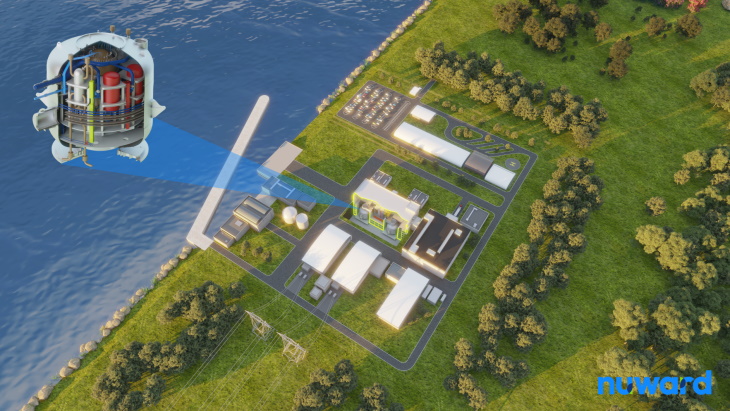
Small Modular Reactors (SMR) are light water reactors that are basically advanced versions of the reactors in service today, except that they are smaller and can be mass-produced like motor cars. These aim at bringing down the costs of nuclear energy by introducing factory manufacturing techniques. Essentially, the idea is to create small, standardized reactors with a capacity of less than 300 MWe each.
Unlike conventional reactors, SMRs are not large civil engineering projects that can take 20 years to bring online and another 20 to turn a profit. Instead, as the name implies, SMRs are based on a smaller, simpler design made up of modules of not only the reactor, but also most of the support components as well.
This allows power plants to be built in factories or shipyards as robust modules, then shipped to the site for assembly. The goal is to not only bring down costs, but also to radically speed up plant construction and certification to begin operation.
Another advantage of SMRs is that plant configuration can be adapted to meet different customers' needs. Small, relatively isolated communities can order single-reactor plants that can serve, for example, a few thousand homes and businesses, while large cities can have plants with multiple reactors that can provide electricity to millions. Since they're small, SMRs can be used for specialized applications like oil exploration or serving military bases. In addition, modules can be designed to be shipped by the most appropriate means, including by barge, ship, truck, train, or even airship.
SMRs are also notable for incorporating passive safety systems that require little or no electrical power to operate and provide cooling if an accident occurs. They are also easier to shield without requiring massive concrete structures because they can be easily installed underground or aboard ships or sea platforms where they sit below the water line, which shields them in the same way as the reactor on a submarine.
High Temperature Gas-Cooled Reactor (HTGR)
A High Temperature Gas-Cooled Reactor (TGR) is a graphite-moderated helium-cooled reactor that operates at temperatures two or three times those of conventional reactors, but with a lower power density. The concept has been under development since the 1940s, but it's only been in recent years that the technology has begun to mature.
The basis for the HTGR is that it runs on TRi-structural ISOtropic (TRISO) particle fuel. Instead of being formed into rods, TSRIO fuel is made of poppy-seed-sized particles consisting of uranium, carbon and oxygen sealed in three layers of carbon or ceramic materials to contain nuclear waste products.
These particles are formed into cylindrical pellets or billiard-ball-sized spheres called "pebbles." This makes the fuel very robust. It is more resistant to neutron irradiation, corrosion, oxidation, and high temperatures than conventional fuels. This means the pebbles won't melt in the reactor, which can run at higher temperatures. In addition, the pebbles can slowly circulate through the reactor, with spent pebbles being removed from the bottom of the reactor while fresh pebbles are introduced to replace them at the top.
Gas-Cooled Fast Reactor (GFR)
Gas-Cooled Fast Reactors (GFR) are also cooled by helium, but operate at a higher power density than an HTGR. They were originally developed as breeder reactors, which produce more fuel than they burn by converting thorium or non-fissile uranium isotopes into plutonium or fissile uranium isotopes, by using fast neutrons instead of the slow neutrons produced by conventional reactors.
The advanced versions of the GFR use a core made of ceramic uranium mono-carbide fuel to allow it to operate at high temperatures. The fuel is also configured so there's a high density of uranium atoms per volume of fuel.
Sodium Fast Reactor (SFR)
Another fast reactor is the Sodium Fast Reactor (SFR), which is cooled by liquid sodium, which has very good heat removal capability. These are small reactors because this allows for inherent and passive safety features that don't work very well in larger sodium reactors. In the United States, the fuel used is a metallic alloy of uranium and zirconium clad in steel, while in Russia, France, and Japan the preference is for uranium oxide fuels. These fuels have low thermal density, so if the reactor core gets too hot, it expands, causing the nuclear reaction to naturally die down.
The core is also very compact because the SFR has a closed fuel cycle. That is, the uranium and plutonium are recycled inside the core as part of the nuclear reaction, allowing the reactor to run for decades between refueling.
Lead-Cooled Fast Reactor (LFR)
The Lead-Cooled Fast Reactor (LFR) is based on a reactor design developed for Russian nuclear submarines and, as the name suggested, uses lead as its cooling element. The latest versions run on uranium nitride instead of uranium dioxide. As with sodium, lead provides a similar passive safety system that automatically regulates the nuclear reaction if it starts to go out of control.
Fluoride-Cooled High Temperature Reactor (FHR)
Fluoride-Cooled High Temperature Reactors (FHR) are high-temperature reactors that are cooled by a molten mixture of lithium fluoride and beryllium fluoride salts instead of helium. These reactors have up to 10 times the power density of an HTGR using TRISO-particle fuel technology. The fluoride salts allow the reactor to run at lower temperatures compared to helium-cooled reactors and future designs will use pebble fuels.
Molten Salt-Fueled Reactor (MSR)
The Molten Salt-Fueled Reactor (MSR) is a bit of a twofer, where the molten salt is both the coolant and the fuel. Instead of being formed into rods, pellets, or pebbles, the fuel is mixed into the fluoride salt, which flows through graphite or a similar moderator that generates slow neutrons and controls the reaction.
MSRs can operate at higher temperatures, though this introduces corrosion problems, so the designs tend toward cooler versions. However, by combining the coolant and the fuel, removing wastes and introducing new fuel is much easier than in conventional reactors.
Beyond Gen IV
As the demand grows for carbon-free energy leads to more nuclear plants being built around the world, we'll be seeing these Generation IV reactors coming online. Since they're designed to be cheaper and faster to build, they'll very likely become very common very fast. But what will come after Generation IV? What will Generation V be like?
In many ways, they'll be more advanced versions of the Generation IV reactors, building on the lessons learned by the previous generation, but we are also likely to see new nuclear plants for new niche applications. There are already plans to build small reactors for use on the Moon, and work is being done on technologies like nuclear fuel that burns like a candle, with the reaction starting at one end and moving to the other as it gradually eats through the fuel.
We may also see a revisiting of other approaches to nuclear reactor design that are based on experiments conducted decades ago, but were abandoned in favor of more promising solutions. Some of these were so thoroughly abandoned that even experts in the field have only a hazy understanding of them. Now, they're being looked at again. Perhaps there will be a day when the term “nuclear fuel” will mean not only uranium and plutonium, but also lesser known ones like thorium.
Of course, if nuclear fusion is ever made practical, then all bets will be off as nuclear fission will likely go the way of the coal-fired locomotive.