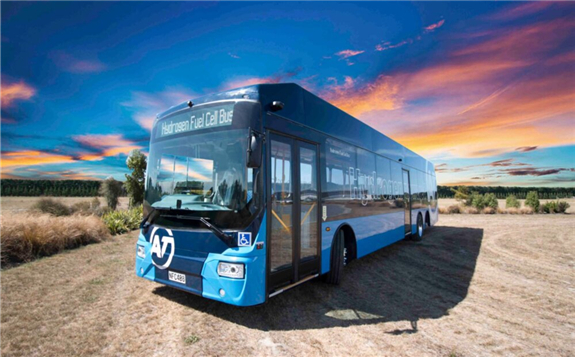
At Guangdong Nation Synergy Hydrogen Power Technology, or Sinosynergy, workers were seen during a recent visit installing storage bottles and hydrogen fuel stacks on a vehicle before its delivery to Ningxia province in northwestern China.
The vehicle looked much like any commuter bus on the road, with doors front and aft, two dozen seats and standing room. But when it gets going, the bus is powered entirely by burning hydrogen, in a process that generates water vapour as its sole by-product without any carbon dioxide or other climate-changing greenhouse gases.
Do you have questions about the biggest topics and trends from around the world? Get the answers with SCMP Knowledge, our new platform of curated content with explainers, FAQs, analyses and infographics brought to you by our award-winning team.
The discreet look of the buses bound for Ningxia, one of China's most impoverished regions, belies Sinosynergy's ambitions in pushing for the embrace of hydrogen fuel cells. The company, which marks its seventh birthday on June 30, produces 70 per cent of China's fuel cell stacks at the heart of the fuel-cell system.

Workers assembled a hydrogen fuel-cell bus at Sinosynergy's headquarters in Yunfu, Guangdong province, on May 21, 2022. Photo: Yujie Xue alt=Workers assembled a hydrogen fuel-cell bus at Sinosynergy's headquarters in Yunfu, Guangdong province, on May 21, 2022. Photo: Yujie Xue>
The display at the entrance of Sinosynergy's headquarters in Yunfu offers a hint of the company's vision and ambition: miniature buses, trucks, trams, passenger cars and ships, aircraft, rockets and 5G telecommunication base stations can all be powered by hydrogen fuel cells in the future. The company has nearly 5,000 vehicles running around the world using its stacks, or one in every two fuel-cell vehicles in China for a global market share of 10 per cent.
"The hydrogen industry has evolved to the early stage of commercialisation and industrialisation," Sinosynergy's international head Cynthia Zhu said in an interview with South China Morning Post during a visit. "Similar to the development of the lithium-ion battery industry, the development of the hydrogen industry cannot take place without an efficient and effective regulatory framework, policy support, and technology advancement."
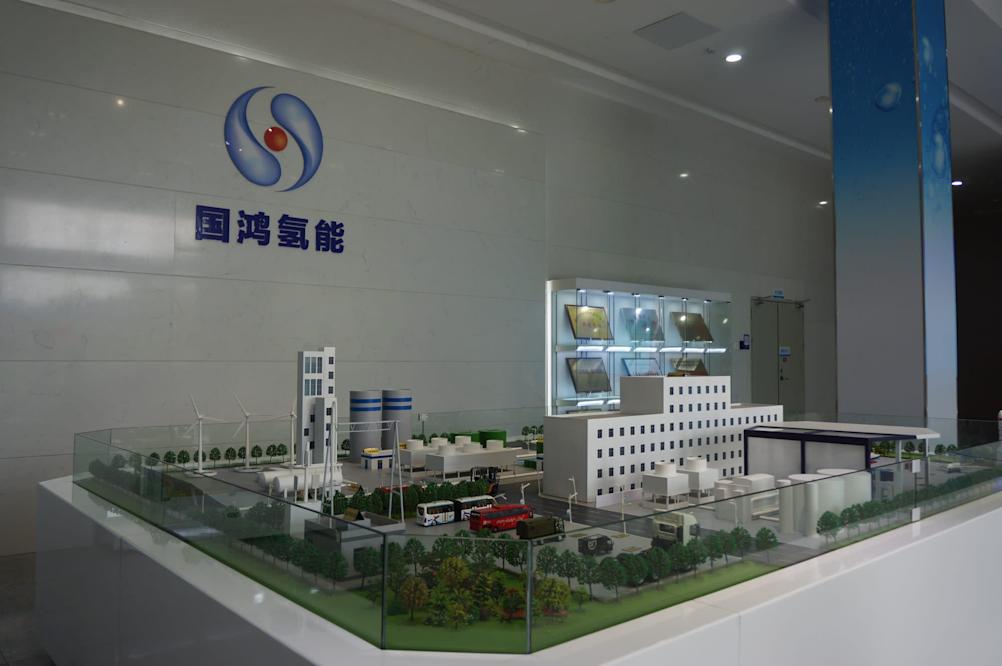
Miniature-scale models of the hydrogen supply chain at Sinosynergy's headquarters in Yunfu, Guangdong province. Photo: Yujie Xue alt=Miniature-scale models of the hydrogen supply chain at Sinosynergy's headquarters in Yunfu, Guangdong province. Photo: Yujie Xue>
The world's emissions of greenhouse gases must peak by 2025 to limit global warming to 1.5 degrees Celsius by this century, according to projections by the United Nations' Intergovernmental Panel on Climate Change (IPCC). That must be reduced by 43 per cent by 2030 before reaching net neutrality by the early 2050s.
As the countdown for saving the Earth from climate change intensifies, the world is racing for new energy solutions to reshape our life and economy and curb greenhouse gas emissions.
The European Union and 33 regions including China and Hong Kong have set targets to achieve net-zero emissions, with China setting its net-zero target in 2060.
This is where hydrogen comes in. As the simplest possible molecule and the most abundant element in the universe, hydrogen is regarded as the ultimate, non-polluting fuel and energy-storage medium of the future.
Compared to solar and wind, hydrogen power does not fluctuate or depend on gusts or sunshine. Stacked against lithium-ion batteries, hydrogen fuel cells have a greater energy storage density, which can power vehicles to go further before refuelling.
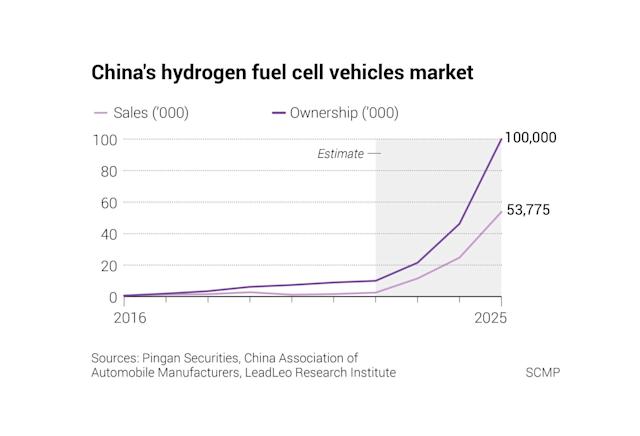
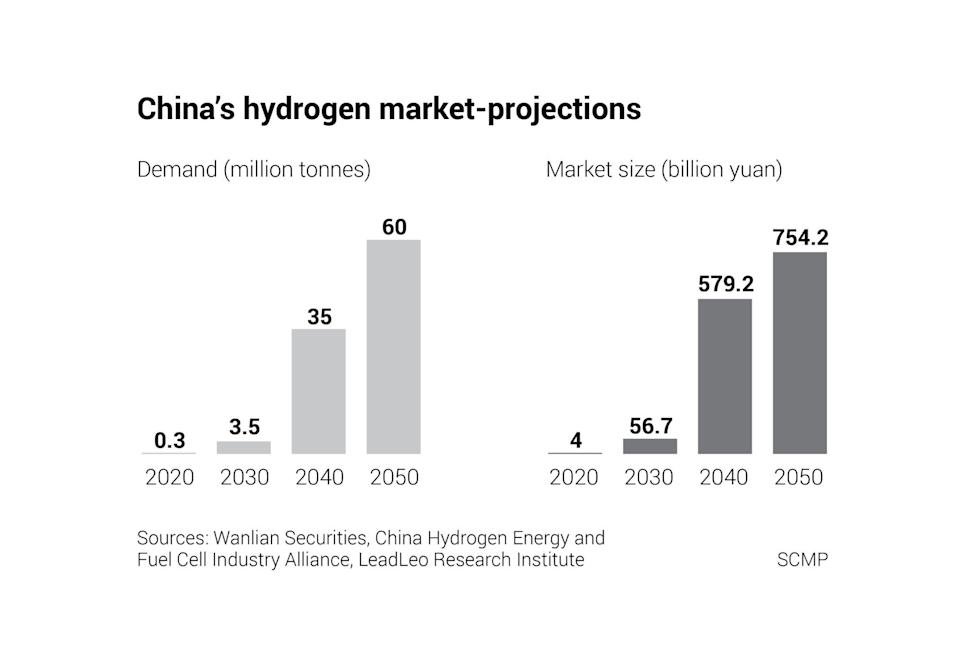
Seeing the advantages of hydrogen, governments around the world have issued ambitious plans to accelerate the development of the hydrogen economy. In March, the Chinese government released the country's first-ever long-term plan for hydrogen from 2021 to 2035. By 2025, China should have at least 50,000 hydrogen fuel-cell electric vehicles on the road, six times more than the 8,000 units in 2020, according to the plan.
The global market for commercial hydrogen fuel-cell vehicles may balloon to US$20 billion by 2030 at a compound annual growth rate of 34 per cent, helped by policies that advocate for clean energy, rapidly falling costs of hydrogen technology and products, and strategic planning, according to the McKinsey Center for Future Mobility.
Sinosynergy has the capacity to produce 20,000 hydrogen fuel-cell stacks every year, claiming to be one of the world's largest producers. Vehicles powered by its stacks are used in over 30 cities across 18 provinces in China, and it was the first Chinese company to export Europe-standard hydrogen-powered vehicles - three fuel cell buses - to Malaysia in 2019.
The company said it benefited tremendously from state support and subsidies since it was established in 2015. Local authorities of Foshan and Yunfu helped and supported Sinosynergy when the two cities decided to develop the local hydrogen industry, including launching industrial parks and local hydrogen bus lines.
Sinosynergy formed a venture with Canada's Ballard Power Systems to localise the production of hydrogen fuel-cell stacks in China. From there, Sinosynergy iterated its scale and developed its own technology. With state support, more companies and capital gathered in the two pioneer cities to form a local industrial ecosystem spanning hydrogen production, storage, refuelling, and application.
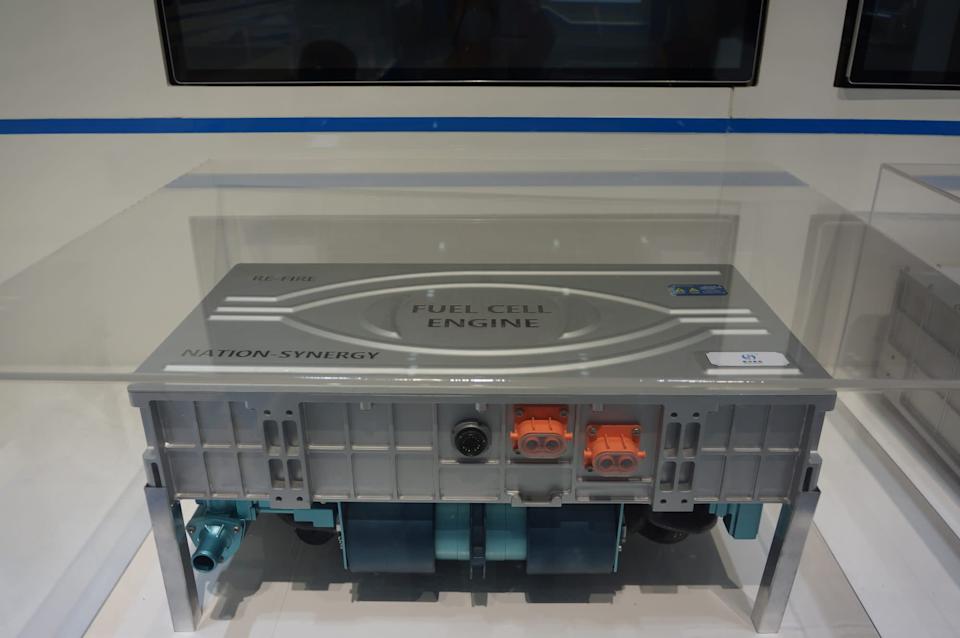
A model of a hydrogen fuel-cell engine developed by Sinosynergy is displayed at its headquarters in Yunfu, Guangdong province. Photo: Yujie Xue alt=A model of a hydrogen fuel-cell engine developed by Sinosynergy is displayed at its headquarters in Yunfu, Guangdong province. Photo: Yujie Xue>
Guangdong's hydrogen industry also got the highest attention from the Communist Party leadership, keen to embrace most aspects of new technology to claim a stake in the future. Vice-Premier Hu Chunhua visited Sinosynergy and Yunfu's hydrogen industrial estate three times between 2015 and 2017 while he was the provincial Commissar in Guangdong.
Since the Chinese government's endorsement of hydrogen in 2019, at least 23 of 31 provincial-level regions have issued development plans for hydrogen energy and fuel-cell vehicles.
Various city and provincial-level governments submitted applications to form hydrogen industrial clusters, including Shanghai, Beijing, and Guangdong, to win the central government's infrastructure funding.
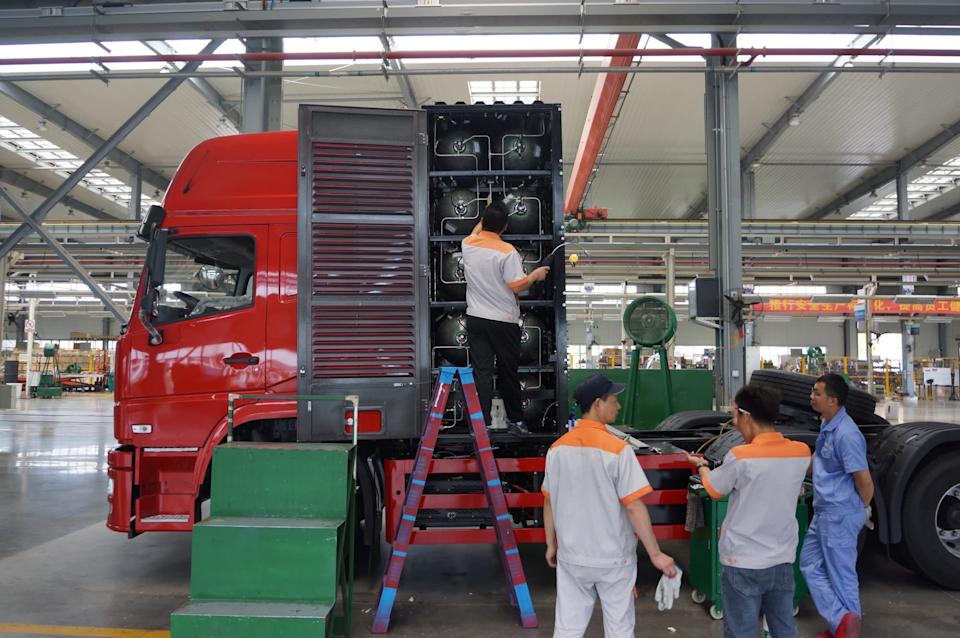
Workers install hydrogen tanks on a fuel-cell truck at Sinosynergy's headquarters in Yunfu, Guangdong province. Photo: Yujie Xue alt=Workers install hydrogen tanks on a fuel-cell truck at Sinosynergy's headquarters in Yunfu, Guangdong province. Photo: Yujie Xue>
Sinosynergy also expanded its product portfolio to span the hydrogen fuel-cell value chain, from stacks and modules to integrated systems and equipment for various end-applications.
In vehicles, Sinosynergy worked with Chinese e-commerce giant JD.com to deliver fuel-cell lorries to serve its nationwide logistics network and helped the Shanghai government launch its hydrogen-powered tram in 2021. It also launched fuel-cell powered forklifts in February in Shanghai with Jungheinrich, based in Hamburg, Germany.
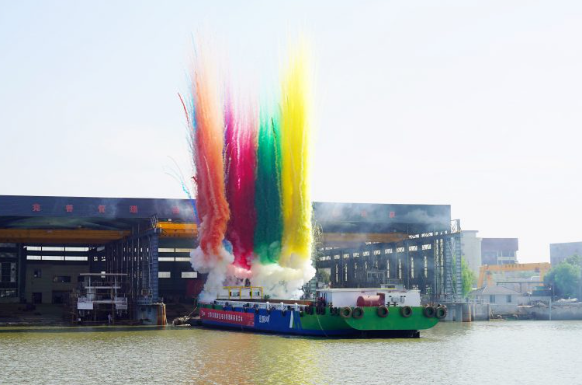
Beyond land transport, Sinosynergy is partnering with China Tower and China's three major telecoms providers to develop standby power supply systems for 5G base stations. Sinosynergy also signed agreements with Guangdong's shipyards to develop hydrogen power solutions for marine transport.
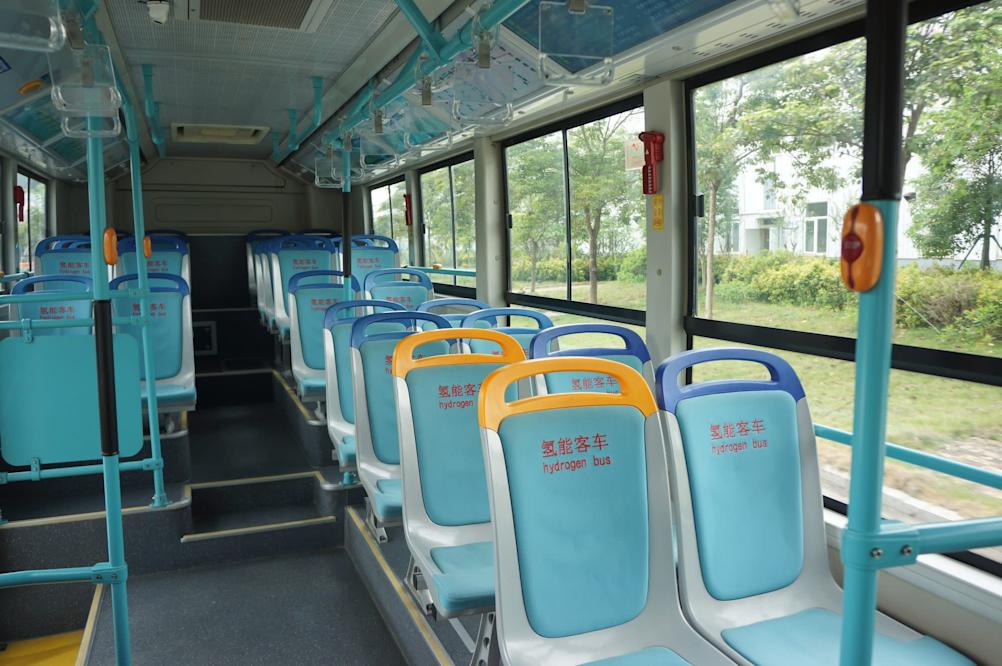
The interior of a hydrogen fuel-cell bus commercially operating in Yunfu, Guangdong province. Photo: Yujie Xue alt=The interior of a hydrogen fuel-cell bus commercially operating in Yunfu, Guangdong province. Photo: Yujie Xue>
Hydrogen fuel-cell buses are quieter and do not smell of petrol like vehicles powered by internal combustion engines (ICEs), a driver said at the hydrogen refuelling station near Sinosynergy's headquarters.
A fuel-cell bus takes around 10 minutes to fully charge, giving it a driving range of 450km (280 miles) on a single charge, said the driver who would only give his surname Zhi.
Hydrogen fuel-cell vehicles have similar mileage as ICE vehicles, around 500 to 600km on a full tank, triple the driving range of battery-powered vehicles, Sinosynergy said. Unlike batteries that may malfunction at extreme temperatures, fuel cells can operate even at around 30 degrees Celsius below freezing point, making them useful in northern China's frigid winters. Ningxia, where temperatures can drop to -15 degrees Celsius in January, offers the ideal testing ground for the fuel cells.
One major obstacle to fuel-cell vehicles' expansion remains the high costs of hydrogen. Currently, the hydrogen used in Yunfu is mainly stored and transported in highly compressed gaseous form, according to Sinosynergy.
The long distances from production facilities to refuelling stations, the high pressure required in storage tanks, as well as the Covid-19 impacts on production supply, have pushed hydrogen prices in Foshan to as high as 70 yuan (US$10.4) to 80 yuan per kg. The average price of petrol in May was about 12.80 yuan per gallon.
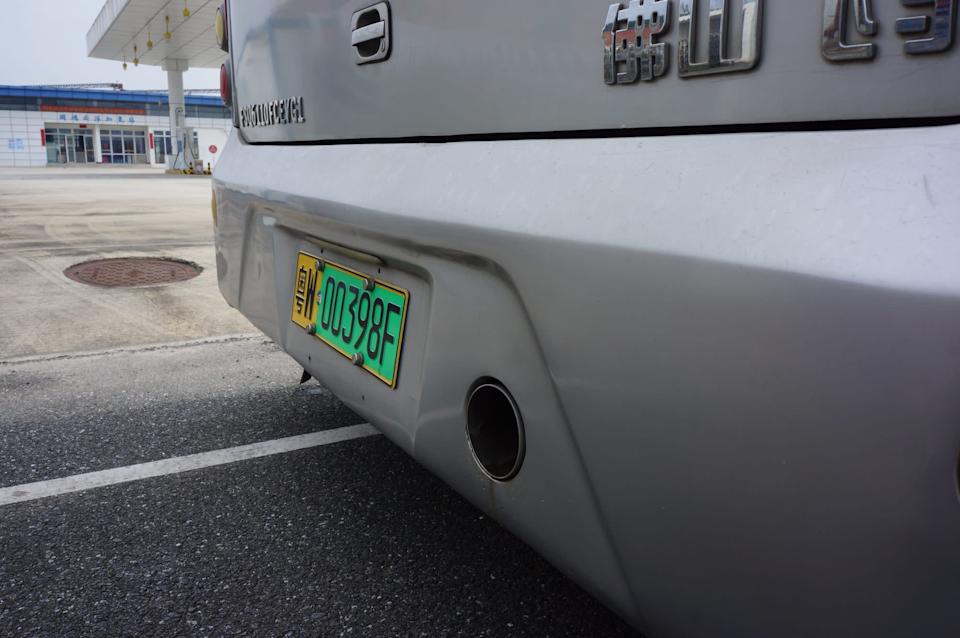
A hydrogen fuel-cell bus emits only water vapour as its sole by-product. Photo: Yujie Xue alt=A hydrogen fuel-cell bus emits only water vapour as its sole by-product. Photo: Yujie Xue>
The other major challenge is the high "green hydrogen" production costs compared to cheaper hydrogen from coal gasification, which has been the go-to technology for industries in China, according to Ankit Sachan, Asia hydrogen analyst at S&P Global Platts Analytics.
China aims to produce 100,000 to 200,000 tonnes of "green hydrogen" - the cleanest form of hydrogen produced by splitting water by electrolysis - annually by 2025, compared to the currently dominant "grey hydrogen" and cleaner "blue hydrogen" generated using coal and natural gas and a by-product of industrial production, which together account for almost all of China's hydrogen production.
By next year, China will have the annual capacity to produce 300,000 tonnes of green hydrogen, according to S&P Global Platts Analytics.
"With the support from the government and the industry, we are confident that the cost of hydrogen will not only be comparable to the current cost of diesel and petrol, but even more competitive," Sinosynergy said in a s statement.
Technological breakthroughs in critical components are also crucial for China's hydrogen development. "Despite recent progress in domestic development, China is still mostly relying on the import of basic materials, catalysts, PEM [polymer electrolyte membrane], carbon paper and high strength carbon fibre," said Ballard's Asia-Pacific managing director Alfred Wong. "Greater international collaboration will help with key component localisation."
Policy support from the government is indispensable for the current and near-term development of hydrogen. China has around 7,700 fuel-cell vehicles, mainly municipal and heavy-duty vehicles deployed by local governments and companies that have received government subsidies, according to S&P Global Platts Analytics.
Hydrogen Industry – 2020 and 2030 by region
Source: S&P Global Commodity Insights
With the advancement in hydrogen fuel-cell technology, falling costs and increasing public awareness, McKinsey estimates that light commercial vehicles will see a compound annual growth rate of over 110 per cent a year to account for over a quarter of the fuel-cell vehicle market in 2030, up from a fraction currently.
The central government's mid and long-term plan issued in March can boost China's hydrogen industry, Sinosynergy's Zhu said.
"With the launch of the medium- and long-term plan for the development of hydrogen energy industry, the challenges in the value chain, including production, storage, transport and refuelling, with the cost of hydrogen, will be solved in the near future," she said. "As a result, the hydrogen industry will attract considerable investment and support from all stakeholders to build a hydrogen economy."
When renewable hydrogen energy technology matures, it will be applied on a large scale, Ballard's Wong said.
"It will gradually cover all sectors that can be decarbonised, such as transport, industry, power generation and raw materials."