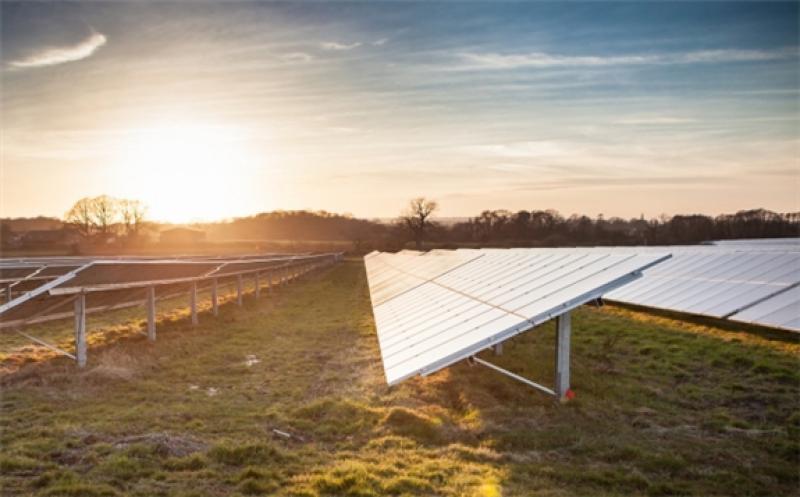
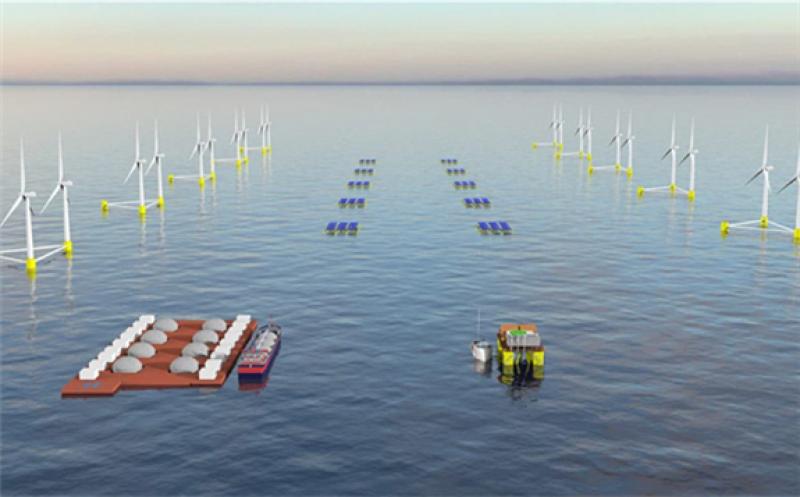
In March 2022, the UK’s Science Minister, George Freeman, revealed the government was mulling over a £16bn proposal to build a solar power station in space, with space-based solar power (SBSP, generally shortened to SSP) featuring as one of the technologies in the government’s Net Zero Innovation Portfolio.
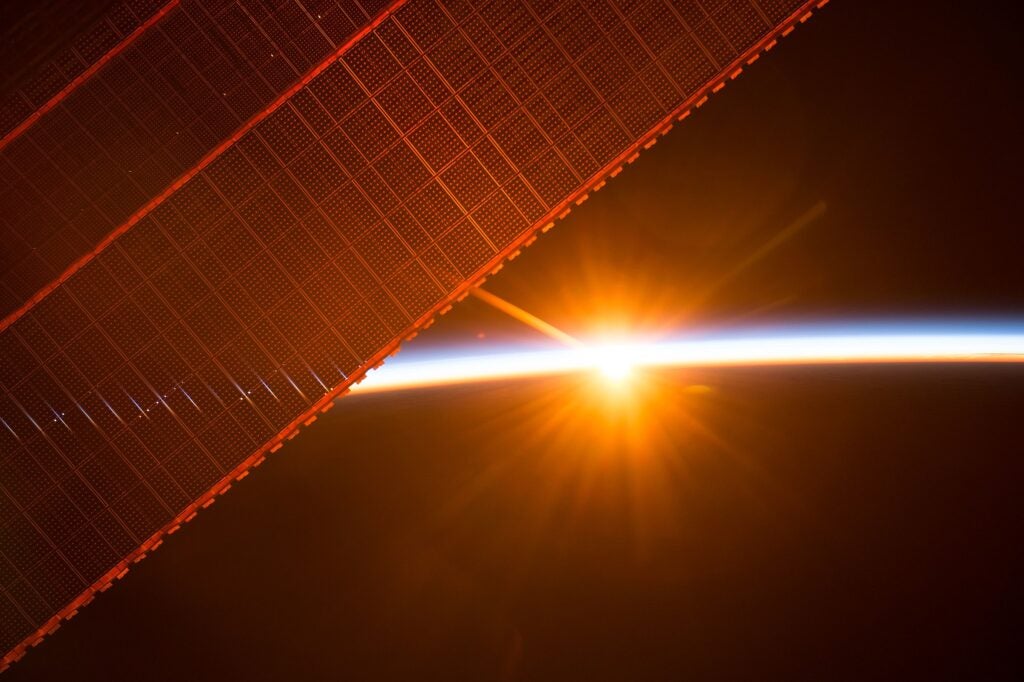
A report for UK authorities by consultancy Frazer-Nash recently described space-based solar as “clear, plentiful and technically possible” by 2040, and US analysis in November 2021 labelled it “one other arrow within the quiver to deal with local weather change”.
But will this futuristic technology ever really transcend the realms of science fiction and, if so, will that be in time to play a starring role in the race to net zero by 2050?
24/7 solar power
An SSP system is essentially a huge spacecraft equipped with an unfurling array of solar panels. As in Asimov’s imaginings, the panels generate electricity that is wirelessly transmitted to Earth using high-frequency radio waves. A ground antenna, a ‘rectenna’, is used to convert the radio waves into electricity, which is then transferred to the power grid. An SSP station in orbit is illuminated by the sun 24 hours a day, generating electricity continuously. This offers an obvious advantage over Earth-based renewable energies, which only generate electricity when the wind blows and the sun shines.
“With global energy demand projected to increase by nearly 50% by 2050, space-based solar power could be key to helping meet the growing demand on the world’s energy sector and tackling global temperature rise,” Jovana Radulovic, Portsmouth University’s head of mechanical and design engineering, wrote in a recent editorial.
Although not a new technology, recent breakthroughs have brought SSP closer to reality. Until the last decade, the technology was written off as uneconomic, primarily due to the extortionate cost of satellite launches. “But there has been a radical change,” says Martin Soltau, space business manager at Frazer-Nash and chair of the UK-based Space Energy Initiative (SEI). “SpaceX has demonstrated reusable rockets and the cost of launch has come down by 90%.”
On top of that, some of the latest solar panel satellite designs are hyper modular – and therefore fit for mass manufacture – dramatically lowering the cost of the hardware. Related technologies such as autonomous robotics and assembly in space have moved on significantly too.
“Overlying all that is the increasing urgency of net zero and a realisation that it is actually going to be incredibly difficult to achieve with current technologies,” says Soltau. “All those issues have come together at the same time, causing a renewed interest in space-based solar.”
The ultimate clean energy
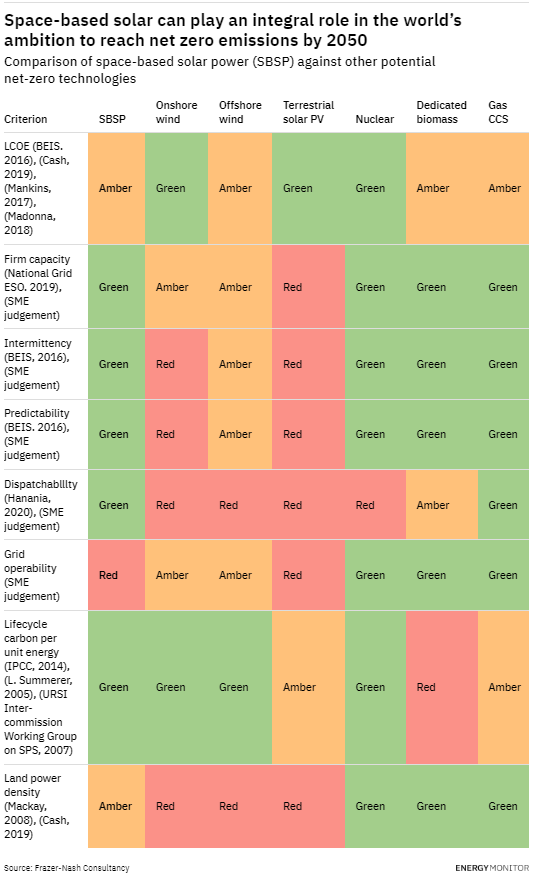
On the face of it, space-based solar power is the ultimate clean energy technology. There is room in orbit for solar power satellites to provide well over 100% of the world’s projected energy demands in 2050, according to the Frazer-Nash report. It would integrate well with intermittent technologies such as wind and terrestrial solar because it is dispatchable – in other words, it can respond quickly to the changing demand caused by the varying output of intermittent energy sources.
SSP would have relatively little environmental impact as Frazer-Nash predicts its ground infrastructure would take up only 8% of the space of a conventional wind farm for the same output – and it could also be moored offshore. The £12.75bn ($16bn) CASSIOPeiA Solar Power Satellite, a prototype satellite solar power design developed by British engineering company International Electric, uses concentrated solar power technology, meaning it needs one six thousandth of the photovoltaic area of a terrestrial solar farm. “This is game-changing for the environmental impact, use of rare earth minerals and system cost,” says Soltau.
A recent life cycle assessment by the University of Strathclyde calculated SSP would have a carbon footprint of 24 gCO2 per kilowatt-hour, which is about half that of terrestrial solar. According to Frazer-Nash, it would also be relatively safe and secure; an encrypted uplink would secure control and accurate orientation, and the peak intensity of the beam of radio waves would be just a quarter that of the midday sun.
Perhaps most importantly, it would be cost-competitive with other energy sources, with Frazer-Nash forecasting a levelised cost of electricity of £26 per megawatt-hour (MWh), around a third of the cost of nuclear energy and cheaper than both wind and terrestrial solar. The SEI, in fact, estimates the development cost to field the CASSIOPeiA system would be closer to £10bn, with the capital cost of each 2GW SSP station estimated at £3.6bn – about a quarter of the cost of a nuclear power station.
“When deployed, it [space-based solar power] will substantially reduce energy bills and provide energy security for households and industry,” says Soltau.
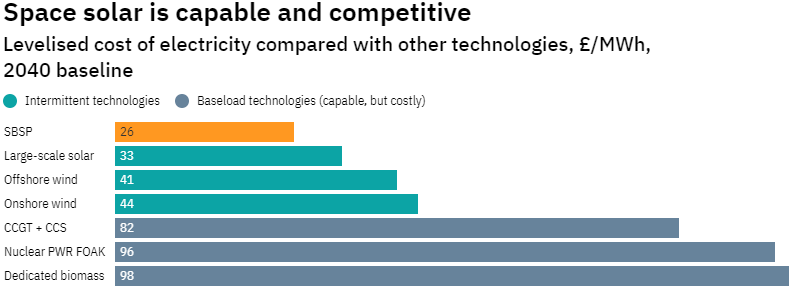
SBSP with 10% hurdle rate. SBSP stands for space-based solar power. CCGT + CCS stands for combined cycle gas turbine plus carbon capture and storage. PWR FOAK stands for pressurised water reactor, first of a kind. Source: Frazer-Nash Consultancy, The Department of Business, Energy and Industrial Strategy, Space Energy Initiative 
The new global space race
A range of industrialised nations are exploring the potential of the technology. In the US, the Space Solar Power Project is developing high-efficiency solar cells as well as an electricity conversion and transmission system optimised for use in space. The US Naval Research Laboratory also tested a solar module and power conversion system in space in 2020.
“The US military developed the ‘sandwich modules’ that are one of the core elements of solar power satellites,” says Soltau. “They have completed power beaming demonstrations up to 1kW and over a distance of a mile. A small test article is currently flying in space aboard the X-37B spaceplane [a re-entry spacecraft designed to operate in low-earth orbit], and demonstrations of power beaming from space are planned for 2025.”
Meanwhile, China recently announced progress on its Bishan space solar energy station and aims to have a functioning system by 2035. Chinese researchers have designed a system called Omega, which should be able to supply 2GW of power to the country’s grid by 2050.
Japan’s space agency is also working on a system, and is planning a power-beaming demonstration from space for 2025. “Japan is probably the world leader in power beaming, with a government-led programme and a declared national policy to develop the technology,” says Soltau.
The European Space Agency is looking to fund SSP projects, and in the UK, the proposed £16bn space-based power system has been deemed a viable concept based on the recent Frazer-Nash research. If commissioned, the project is expected to start with small trials, with the aim of establishing an operational SSP station in 2040. According to Soltau, the working assumption is for the UK to have 15 solar power satellites by 2050, each providing 2GW into the grid. While this is a substantial amount of power – to produce 2GW with solar panels on Earth, you would need more than six million of them – it is modest compared with the UK’s current generation capacity, which is around 76GW.
“With extremely high initial costs and slow return on investment, the project would need substantial governmental resources as well as investments from private companies,” says Portsmouth’s Radulovic. “But as technology advances, the cost of space launch and manufacturing will steadily decrease, and the scale of the project will allow for mass manufacturing, which should drive the cost down.”
The UK’s Department for Business, Energy & Industrial Strategy told Energy Monitor that following the Frazer-Nash report it is developing a small-scale ‘no-regrets’ innovation programme to support the development of key technologies associated with SSP, but that also have broader terrestrial applications so they can contribute to the UK’s net-zero ambition whether SSP takes off or not.
There are also a number of private companies conducting small-scale research and concept studies. The Space Energy Initiative was recently established with the aim of developing a commercial approach to space-based solar. It brings together 50 organisations across the energy, space and finance sectors, encompassing the likes of Airbus, Thales, CGI, the UK Department of Trade, Imperial College London and Cambridge University. “We have just established the company Space Solar Limited to lead a space-based solar development programme, supported by SEI members,” says Soltau.
“The stupidest thing ever”
But the technology is not without its challenges. In fact, in 2012, Elon Musk – who runs both a solar power and a space business – called SSP “the stupidest thing ever”. The weight of solar panels was identified as an early challenge, but that has been addressed by the development of ultra-light solar cells. “Space-based solar power is deemed to be technically feasible primarily because of advances in key technologies including lightweight solar cells, wireless power transmission and space robotics,” says Radulovic.
An SSP station is based on a modular design, involving a large number of modules assembled in orbit by robots. However, transporting all these elements into space is difficult, costly and will take a toll on the environment, according to Radulovic. Assembling even just one space-based solar power station will require numerous space shuttle launches. “Although space-based solar power is designed to reduce carbon emissions in the long run, there are significant emissions associated with space launches,” says Radulovic.
Although companies like SpaceX are working on making space shuttles reusable, the technology is not yet commercially available, and an operational SSP station would face a number of practical challenges. The solar panels would be vulnerable to damage from space debris and, without the shield of the Earth’s atmosphere, would likely degrade at a much faster rate than their terrestrial counterparts because of the intense solar radiation.
The efficiency of the wireless power transmission has also been called into question. Transmitting energy across such large distances is extremely difficult, and based on current technology, “only a small fraction of collected solar energy would reach the Earth”, says Radulovic. Soltau, however, maintains that the efficiency of the system is around 60%. “Efficiency is not the primary performance metric when the fuel (the sun) is free and abundant,” he says.
In time for net zero?
Many of its advocates believe space-based solar can play an integral role in the world’s ambition to reach net-zero greenhouse gas emissions by 2050. The Space Energy Initiative has created a 12-year development plan that would see the first systems deployed by 2035, with several gigawatts of production capacity added annually thereafter. By the mid-2040s, Soltau believes the UK could derive 25% of its electricity generation from space – a production rate he believes is replicable for other nations as well.
“It is a little bit out there, but it is not that far out there,” Brian Ryan, vice-president of innovation for UK utility National Grid, recently told the Week magazine. “I think we will see space-based solar power playing a huge role in our energy ecosystem in the next 20 years... The potential is unlimited.”
Soltau draws the comparison to nuclear fusion, another highly-coveted future clean energy technology that has received considerable levels of investment and attention for its potential to decarbonise the world’s energy system. He points out that while fusion researchers are still exploring ways of getting the physics of the technology to work, with space-based solar “we don’t need any breakthroughs in our understanding of the physics or materials technology or component performance – that is why we have been able to put together a 12-year road map to develop an operational space-based solar powered system”.
Others are less evangelical. Whether SSP can help us meet net zero by 2050 “remains to be seen”, says Radulovic. In her opinion, other technologies, such as diverse and flexible energy storage, hydrogen and growth in renewable energy systems, are better understood and easier to implement.
Nonetheless, despite the technology’s challenges and the varying opinions on the speed of its scale-up, most agree that space-based solar is likely to play a role in the future global energy supply. For that, we have the likes of Mr Asimov to thank.