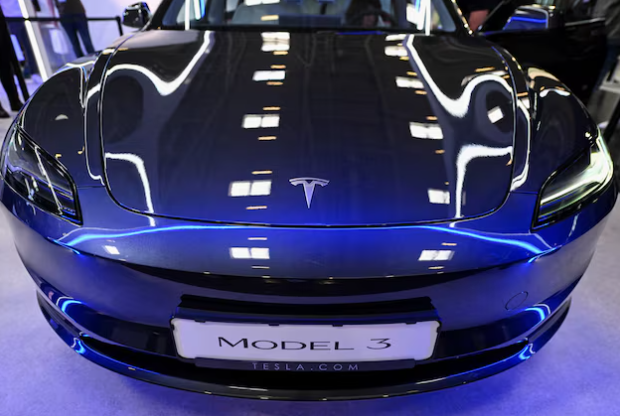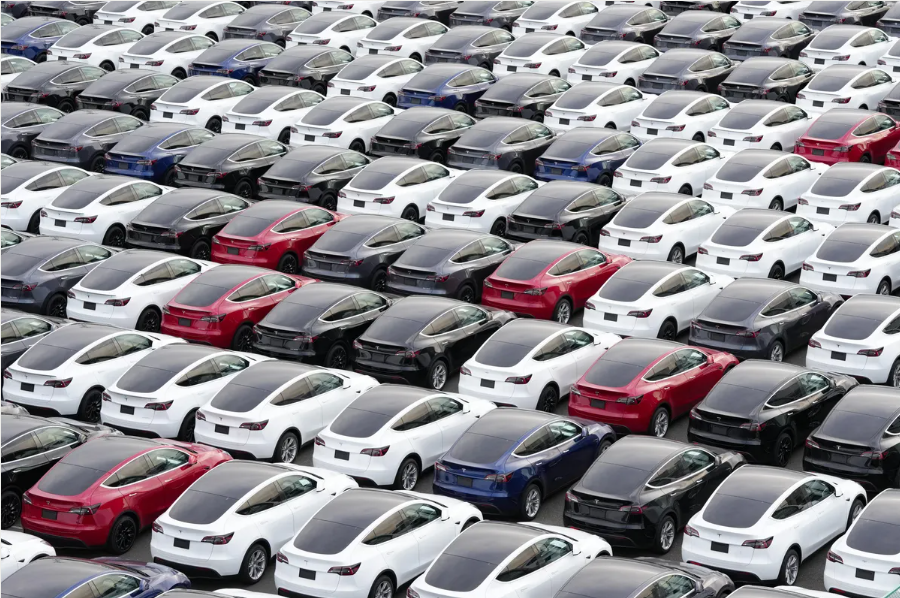
Teslas in a parking lot after arriving at a port in Yokohama, Japan. TORU HANAI/BLOOMBERG/GETTY IMAGES
“Electric cars will not save the climate. It is completely wrong,” Fatih Birol, Executive Director of the International Energy Agency (IEA), has stated.
If Birol were from Maine, he might have simply observed, “You can’t get there from here.”
This is not to imply in any way that electric vehicles are worthless. Analysis by the International Council on Clean Transportation (ICCT) argues that EVs are the quickest means to decarbonize motorized transport. However, EVs are not by themselves in any way going to achieve the goal of net zero by 2050.
There are two major reasons for this: first, EVs are not going to reach the numbers required by 2050 to hit their needed contribution to net zero goals, and even if they did, a host of other personal, social and economic activities must be modified to reach the total net zero mark.
For instance, Alexandre Milovanoff at the University of Toronto and his colleagues’ research (which is described in depth in a recent Spectrum article) demonstrates the U.S. must have 90 percent of its vehicles, or some 350 million EVs, on the road by 2050 in order to hit its emission targets. The likelihood of this occurring is infinitesimal. Some estimates indicate that about 40 percent of vehicles on US roads will be ICE vehicles in 2050, while others are less than half that figure.
For the U.S. to hit the 90 percent EV target, sales of all new ICE vehicles across the U.S. must cease by 2038 at the latest, according to research company BloombergNEF (BNEF). Greenpeace, on the other hand, argues that sales of all diesel and petrol vehicles, including hybrids, must end by 2030 to meet such a target. However, achieving either goal would likely require governments offering hundreds of billions of dollars, if not trillions, in EV subsidies to ICE owners over the next decade, not to mention significant investments in EV charging infrastructure and the electrical grid. ICE vehicle households would also have to be convinced that they would not be giving activities up by becoming EV-only households.
As a reality check, current estimates for the number of ICE vehicles still on the road worldwide in 2050 range from a low of 1.25 billion to more than 2 billion.
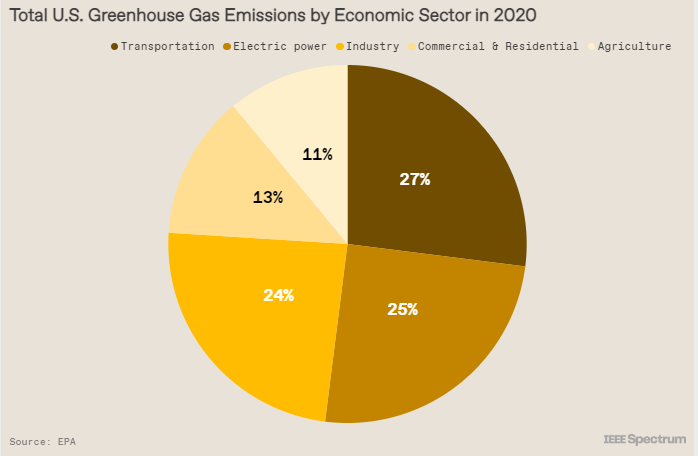
Even assuming that the required EV targets were met in the U.S. and elsewhere, it still will not be sufficient to meet net zero 2050 emission targets. Transportation accounts for only 27 percent of greenhouse gas emissions (GHG) in the U.S.; the sources of the other 73 percent of GHG emissions must be reduced as well. Even in the transportation sector, more than 15 percent of the GHG emissions are created by air and rail travel and shipping. These will also have to be decarbonized.
Nevertheless, for EVs themselves to become true zero emission vehicles, everything in their supply chain from mining to electricity production must be nearly net-zero emission as well. Today, depending on the EV model, where it charges, and assuming it is a battery electric and not a hybrid vehicle, it may need to be driven anywhere from 8,400 to 13,500 miles, or controversially, significantly more to generate less GHG emissions than an ICE vehicle. This is due to the 30 to 40 percent increase in emissions EVs create in comparison to manufacturing an ICE vehicle, mainly from its battery production.
In states (or countries) with a high proportion of coal-generated electricity, the miles needed to break-even climb more. In Poland and China, for example, an EV would need to be driven 78,700 miles to break-even. Just accounting for miles driven, however, BEVs cars and trucks appear cleaner than ICE equivalents nearly everywhere in the U.S. today. As electricity increasingly comes from renewables, total electric vehicle GHG emissions will continue downward, but that will take at least a decade or more to happen everywhere across the U.S. (assuming policy roadblocks disappear), and even longer elsewhere.
If EVs aren’t enough, what else is needed?
Given that EVs, let alone the rest of the transportation sector, likely won’t hit net zero 2050 targets, what additional actions are being advanced to reduce GHG emissions?
A high priority, says IEA’s Birol, is investment in across-the-board energy-related technology research and development and their placement into practice. According to Birol, “IEA analysis shows that about half the reductions to get to net zero emissions in 2050 will need to come from technologies that are not yet ready for market.”
Many of these new technologies will be aimed at improving the efficient use of fossil fuels, which will not be disappearing anytime soon. The IEA expects that energy efficiency improvement, such as the increased use of variable speed electric motors, will lead to a 40 percent reduction in energy-related GHG emissions over the next twenty years.
But even if these hoped for technological improvements arrive, and most certainly if they do not, the public and businesses are expected to take more energy conscious decisions to close what the United Nations says is the expected 2050 “emissions gap.” Environmental groups foresee the public needing to use electrified mass transit, reduce long-haul flights for business as well as pleasure), increase telework, walk and cycle to work or stores, change their diet to eat more vegetables, or if absolutely needed, drive only small EVs. Another expectation is that homeowners and businesses will become “fully electrified” by replacing oil, propane and gas furnaces with heat pumps along with gas fired stoves as well as installing solar power and battery systems.
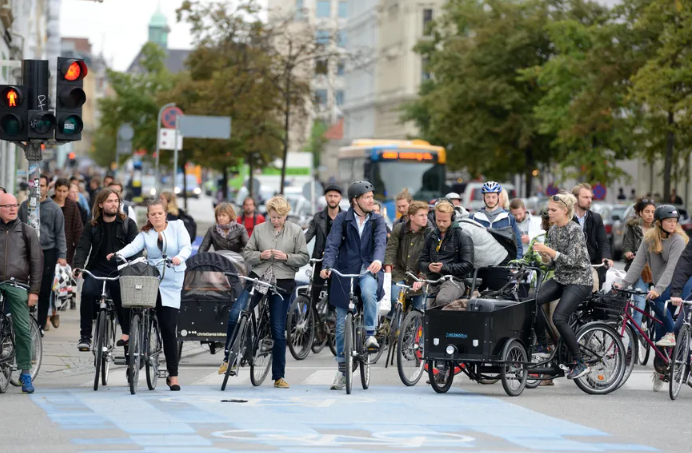
Dronning Louise’s Bro (Queen Louise’s Bridge) connects inner Copenhagen and Nørrebro and is frequented by many cyclists and pedestrians every day.FRÉDÉRIC SOLTAN/CORBIS/GETTY IMAGES
Underpinning the behavioral changes being urged (or encouraged by legislation) is the notion of rejecting the current car-centric culture and completely rethinking what personal mobility means. For example, researchers at University of Oxford in the U.K. argue that, “Focusing solely on electric vehicles is slowing down the race to zero emissions.” Their studyfound “emissions from cycling can be more than 30 times lower for each trip than driving a fossil fuel car, and about ten times lower than driving an electric one.” If just one out of five urban residents in Europe permanently changed from driving to cycling, emissions from automobiles would be cut by 8 percent, the study reports.
Even then, Oxford researchers concede, breaking the car’s mental grip on people is not going to be easy, given the generally poor state of public transportation across much of the globe.
Behavioral change is hard
How willing are people to break their car dependency and other energy-related behaviors to address climate change? The answer is perhaps some, but maybe not too much. A Pew Research Centersurvey taken in late 2021 of seventeen countries with advanced economies indicated that 80 percent of those surveyed were willing to alter how then live and work to combat climate change.
However, a Kanter Publicsurvey of ten of the same countries taken at about the same time gives a less positive view, with only 51 percent of those polled stating they would alter their lifestyles. In fact, some 74 percent of those polled indicated they were already “proud of what [they are] currently doing” to combat climate change.
What both polls failed to explore are what behaviors specifically would respondents being willing to permanently change or give up in their lives to combat climate change?
For instance, how many urban dwellers, if told that they must forever give up their cars and instead walk, cycle or take public transportation, would willingly agree to doing so? And how many of those who agreed, would also consent to go vegetarian, telework, and forsake trips abroad for vacation?
It is one thing to answer a poll indicating a willingness to change, and quite another to “walk the talk” especially if there are personal, social or economic inconveniences or costs involved. For instance, recent U.S. survey information shows that while 22 percent of new car buyers expressed interest in a battery electric vehicle (BEV), only 5 percent actually bought one.
Granted, there are several cities where living without a vehicle is doable, like Utrecht in the Netherlands where in 2019 48 percent of resident trips were done by cycling or London, where nearly two-thirds of all trips taken that same year were are made by walking, cycling or public transportation. Even a few US cities it might be livable without a car.

The world’s largest bike parking facility, Stationsplein Bicycle Parking near Utrecht Central Station in Utrecht, Netherlands has 12,500 parking places.ABDULLAH ASIRAN/ANADOLU AGENCY/GETTY IMAGES
However, in countless other urban areas, especially across most of the U.S., even those wishing to forsake owning a car would find it very difficult to do so without a massive influx of investment into all forms of public transport and personal mobility to eliminate the scores of US transit deserts.
As Tony Dutzik of the environmental advocacy group Frontier Group has written that in the U.S. “the price of admission to jobs, education and recreation is owning a car.” That’s especially true if you are a poor urbanite. Owning a reliable automobile has long been one of the only successful means of getting out of poverty.
Massive investment in new public transportation in the U.S. in unlikely, given its unpopularity with politicians and the public alike. This unpopularity has translated into aging and poorly-maintained bus, train and transit systems that few look forward to using. The American Society of Civil Engineers gives the current state of American public transportation a grade of D- and says today’s $176 billion investment backlog is expected to grow to $250 billion through 2029.
While the $89 billion targeted to public transportation in the recently passed Infrastructure Investment and Jobs Act will help, it also contains more than $351 billion for highways over the next five years. Hundreds of billions in annual investment are needed not only to fix the current public transport system but to build new ones to significantly reduce car dependency in America. Doing so would still take decades to complete.
Yet, even if such an investment were made in public transportation, unless its service is competitive with an EV or ICE vehicle in terms of cost, reliability and convenience, it will not be used. With EVs costing less to operate than ICE vehicles, the competitive hurdle will increase, despite the moves to offer free transit rides. Then there is the social stigma attached riding public transportation that needs to be overcome as well.
A few experts proclaim that ride-sharing using autonomous vehicles will separate people from their cars. Some even claim such AV sharing signals the both the end of individual car ownership as well as the need to invest in public transportation. Both outcomes are far from likely.
Other suggestions include redesigning cities to be more compact and more electrified, which would eliminate most of the need for personal vehicles to meet basic transportation needs. Again, this would take decades and untold billions of dollars to do so at the scale needed. The San Diego, California region has decided to spend $160 billion as a way to meet California’s net zero objectives to create “a collection of walkable villages serviced by bustling (fee-free) train stations and on-demand shuttles” by 2050. However, there has been public pushback over how to pay for the plan and its push to decrease personal driving by imposing a mileage tax.
According to University of Michigan public policy expert John Leslie King, the challenge of getting to net zero by 2050 is that each decarbonization proposal being made is only part of the overall solution. He notes, “You must achieve all the goals, or you don’t win. The cost of doing each is daunting, and the total cost goes up as you concatenate them.”
Concatenated costs also include changing multiple personal behaviors. It is unlikely that automakers, having committed more than a trillion dollars so far to EVs and charging infrastructure, are going to support depriving the public of the activities they enjoy today as a price they pay to shift to EVs. A war on EVs will be hard fought.
Should Policies Nudge or Shove?
The cost concatenation problem arises not only at a national level, but at countless local levels as well. Massachusetts’ new governor Maura Healey, for example, has set ambitious goals of having at least 1 million EVs on the road, converting 1 million fossil-fuel burning furnaces in homes and buildings to heat-pump systems, and the state achieving a 100 percent clean electricity supply by 2030.
The number of Massachusetts households that can afford or are willing to buy an EV and or convert their homes to a heat pump system in the next eight years, even with a current state median household income of $89,000 and subsidies, is likely significantly smaller than the targets set. So, what happens if by 2030, the numbers are well below target, not only in Massachusetts, but other states like California, New York, or Illinois that also have aggressive GHG emission reduction targets?
Will governments move from encouraging behavioral changes to combat climate change or, in frustration or desperation, begin mandating them? And if they do, will there be a tipping point that spurs massive social resistance?
For example, dairy farmers in the Netherlands have been protesting plans by the government to force them to cut their nitrogen emissions. This will require dairy farms to reduce their livestock, which will make it difficult or impossible to stay in business. The Dutch government estimates 11,200 farms must close, and another 17,600 to reduce their livestock numbers. The government says farmers who do not comply will have their farms taken away by forced buyouts starting in 2023.
California admits getting to a zero-carbon transportation system by 2045 means car owners must travel 25 percent below 1990 levels by 2030 and even more by 2045. If drivers fail to do so, will California impose weekly or monthly driving quotas, or punitive per mile driving taxes, along with mandating mileage data from vehicles ever-more connected to the Internet? The San Diego backlash over a mileage tax may be just the beginning.
“EVs,” notes King, “pull an invisible trailer filled with required major lifestyle changes that the public is not yet aware of.”
When it does, do not expect the public to acquiesce quietly.