India’s government is pushing for construction of more nuclear power plants as the country looks to increase its supply of cleaner energy. Officials have made some ambitious pronouncements, calling for as many as 20 new nuclear power facilities to be brought online over the next decade, more than doubling the number of operating nuclear power plants in the country. Officials in February announced that Haryana state in northern India will be home to that region’s first nuclear plant, as a 1,400-MW facility already is under construction near Gorakhpur village, about 90 miles northwest of New Delhi. That plant will feature two 700-MW pressurized heavy-water reactors (PHWR) of Indian design.
The U.S. and India in 2019 signed a deal in which the U.S. pledged to support construction of at least six nuclear power plants in India, and the two countries in February revisited previous agreements from as long ago as 2008 that could facilitate U.S. backing of India’s nuclear power program. Officials in India also have signed civil nuclear cooperation agreements with another dozen countries, including Russia, Canada, and France, that would support the deployment of additional reactors. The Nuclear Power Corp. of India (NPCI) has received government backing to build a series of 700-MW PHWR reactors as part of the country’s domestic nuclear power program. Westinghouse and the NPCI in 2016 had a broad agreement for the U.S. company to build as many as six reactors in India, but the deal collapsed after Westinghouse declared bankruptcy in 2017.
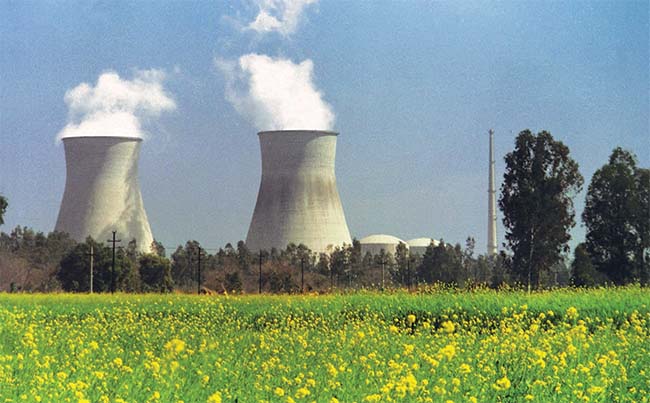
India’s Narora Atomic Power Station features two of the 22 operating nuclear reactors in the country, which has about 6.8 GW of installed nuclear power capacity. The Narora station has 440 MW of generation capacity. Courtesy: Government of India
Jitendra Singh, India’s Union Minister of State for Atomic Energy, said the agency is working with Prime Minister Narendra Modi’s regime on the installation of nuclear power plants in new areas. Most of India’s operating reactors are located in the southern and western parts of the country (Figure 1). Singh earlier this year said the government is seeking investment from companies in the public sector to help advance India’s nuclear power and other energy goals. Modi’s government has talked about a goal of having 500 GW of energy from non-fossil fuel sources by 2030, which would require a rapid ramp-up of nuclear and renewable energy generation capacity. Singh said Modi’s government already has given approval for construction of at least 10 new nuclear reactors.
Fast additions of nuclear power likely would require changes to India’s historical construction timelines of new reactors. An analysis of data from the International Atomic Energy Agency released earlier this year shows the median construction time for nuclear plants in India historically has been just more than 14 years, from the start of construction until connection to the power grid. Officials have said the country must improve that mark to achieve its nuclear power goals, citing the same analysis that shows China has been building and commissioning nuclear reactors in fewer than six years.
“India is looking to reduce its fossil fuels by half by 2032; building nuclear plants is seen as a central part of that strategy,” said Irina Tsukerman, a geopolitical analyst and president of Scarab Rising, a Connecticut-based business advisory group. “From a safety perspective, it is not a significant risk given that India is already a nuclear power. Civilian plants would not necessarily introduce any greater risk; the key would be cooperation with reputable companies and Western states toward building safe and well-maintained facilities.”
U.S. Assistant Secretary of State for Energy Resources Geoffrey Pyatt met with Indian officials in Delhi in mid-February, and described India as a “very crucial” partner for supporting global energy security as the world continues to face issues stemming from Russia’s invasion of Ukraine. Pyatt told local media, “The business model of the civil nuclear industry is changing. In the U.S., we made a huge commitment to small and marginal reactors which could be particularly suitable to the Indian environment as well.”
Pyatt, who was an official at the U.S. Embassy in New Delhi for several years and worked on a nuclear cooperation agreement between the U.S. and India that was approved by Congress in 2008, said, “The U.S.-India energy and climate agenda is one of the most important that we have anywhere in the world. When I look at where our strategic relationship is going, I see the issues that I am now responsible for as being right at the center of the picture because there is so much potential to build on the strong foundation to do even more,” he said.
Pyatt said his visit was designed to strengthen a bilateral energy partnership between the U.S. and India. He noted that partnership also would include projects under the “Quad” framework, a working group that includes Japan and Australia, and is focused on cooperation of the countries in the Indo-Pacific region. U.S. Secretary of State Antony Blinken, along with India’s External Affairs Minister S Jaishankar, Japan’s Minister for Foreign Affairs Yoshimasa Hayashi, and Australian Minister for Foreign Affairs Penny Wong, met in New Delhi in early March to discuss an agenda for the region, including a clean energy transition.
“The Indian government is indeed pushing nuclear particularly strongly and the current plans may lead to tripling the nuclear power generation capacity in the next 10 years,” said François Le Scornet, president and Cleantech & Climate Tech senior consultant at Carbonexit Consulting in France. “Despite this impressive increase in capacity, nuclear would only represent a small fraction of the Indian power mix and renewables are also expected to boom during the same period.”
“Currently, India only has 6.8 GW of nuclear power, barely 1.7% of its total generation fleet,” said Tsukerman. “However, India does not just wish to diversify its energy sources, it has aspirations to become a global leader in nuclear technology. The shift toward nuclearization would need to be seismic for that to happen given the low levels of nuclear power it has now. Importantly, India is looking to put its expertise in fast reactors and [the] thorium nuclear fuel cycle to good use in that regard.”
“India has a long history of international discussions and negotiations with foreign nuclear vendors, from Canadian, Russian, French to American and Japanese reactor manufacturers,” said Le Scornet. “In addition, the country developed its own technology and India has a largely indigenous nuclear power program today. For instance, the development of 700-MWe PHWRs is to be managed purely based on local capacities and India aims to develop a larger model as well.” India’s PHWRs, designed by NPCI, which also builds, commissions, and operates the country’s reactors, use uranium as fuel and heavy water as a moderator. NPCI operates under the Indian government’s Department of Atomic Energy.
“Foreign companies like Areva and Westinghouse have had in-depth discussion with Indian authorities about new projects that focus on larger reactor models, with EPR [evolutionary pressurized water reactor] models at Jaitapur and the [Westinghouse] AP1000 model at Kovvada and/or Chhaya-Mithi Virdi, respectively. Russian AES-2006 and VVER-1200 models are also considered for other sites as well,” said Le Scornet.