Understanding why certain materials work better than others when it comes to energy storage is a crucial step for developing the batteries that will power electronic devices, electric vehicles and renewable energy grids. Researchers at Drexel University have developed a new technique that can quickly identify the exact electrochemical mechanisms taking place in batteries and supercapacitors of various compositions—a breakthrough that could speed the design of higher performing energy storage devices.
Reported in Nature Energy, the Drexel team's method combines two well-established scientific research procedures, one used to determine the composition of chemical compounds by their ability to absorb visible light and another that measures the electrical current of energy storage devices, like batteries and supercapacitors.
By running these tests concurrently, the researchers have achieved a more precise way of tracking the transfer of ions within the devices—revealing the intricate electrochemical process that governs the generation of usable power.
Getting a better look
"Though it has been a well-studied field for decades, we still do not fully understand the mechanisms of electrochemical processes in various energy storage systems," said Danzhen Zhang, a doctoral student in the Department of Materials Science and Engineering in Drexel's College of Engineering, and a co-author of the paper.
"While we have a conceptual understanding of electrochemical reactions involved, quantifying and observing these complex electrochemical systems in a meaningful way during their operation is extremely difficult and remains an ongoing area of research."
The challenge lies in the fact that it's not actually possible to see ions—the charged atomic particles packed into a device as it charges and whose movement creates the electric current that enables it to power a device. They're too small and they move too quickly. The best researchers can do is to rely on the signals that indicate where they are likely present—a sort of low-resolution atomic radar—firing particles at them and recording what bounces off.
Without being able to see how ions are arranging themselves within, atop and between the energy storage compartments of the device, called electrodes, it can be quite challenging to properly design them to maximize energy storage area and facilitate orderly entrance and exit for the ions.
"It would be like opening your pantry door with your eyes closed and taking a sniff inside to determine if you have enough room for a few more cans of soup," said John Wang, Ph.D., a postdoctoral research associate in the College of Engineering, and a co-author of the paper.
"Right now, it remains challenging to make direct measurements and observe how energy storage devices perform. It would be much better if we could get a good look at the atomic structure so we know how and where the ions will fit—then maybe we can design a structure that can accommodate a lot more of them. We believe that the method we've created will allow us to make those measurements and adjustments."
Trying to fit in
The three most common ways ions assemble at an electrode are within its atomic layers, on its surface or atop other ions already on its surface.
Each of these arrangements has benefits and drawbacks when it comes to battery or supercapacitor performance. Entering, or intercalating, into the electrode material's layers allows more ions—energy—to be stored. Attaching and detaching to the surface of the material, called a surface redox reaction, enables a quick release of energy. And perching with solvent molecules atop a layer of ions on the surface, an electrical double-layer reaction, allows for a slightly larger power discharge but less energy.
Researchers can observe how long it takes a storage device to discharge and charge again, or test the electrode material at the beginning and end of a discharge cycle to get a pretty good idea of the predominant storage mechanism.
A troubling secret
But recent research suggests that these energy storage mechanisms may not always occur as ordered, discrete reactions. There are a number of reactions happening with mixed or intermediate mechanisms. So, accurately distinguishing them and fundamentally understanding them is important for improving the performance of energy storage devices.
Being able to precisely quantify and keep track of ions within an electrode and track them over the course of its charge-discharge cycles will give researchers a better picture of all the reactions taking place—and, importantly, identify the parasitic side reactions that may hinder the performance of the device.
Armed with this information, designers could better tailor electrode materials and electrolytes to enhance performance and limit degradation.
An enlightening combination
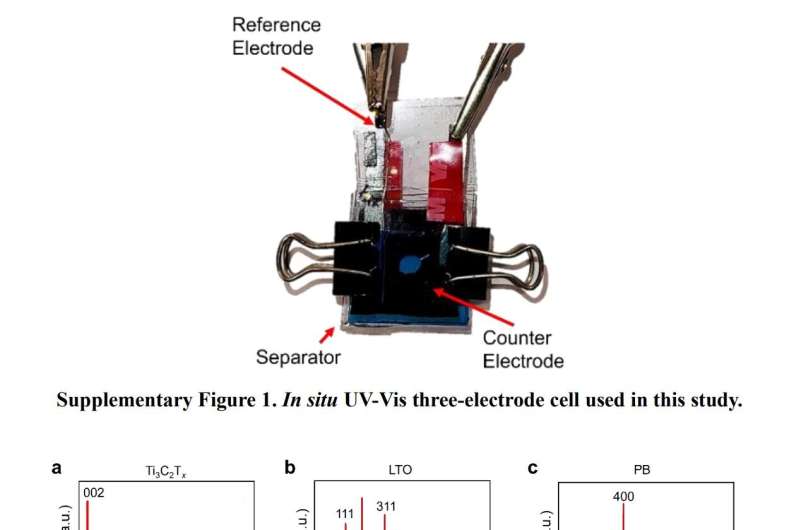
The Drexel team's new method offers a way to monitor both the positioning and movement of ions from electrolyte to electrode within an energy storage device. Their approach combines ultraviolet-visible (UV-vis) spectroscopy—a method for determining the chemical composition of a compound by how it absorbs light—with a method that measures the electrical current during charge-discharge cycles, called cyclic voltammetry (CV).
Their breakthrough came when the group used UV-vis spectroscopy to observe the electrochemical interaction in thin nanomaterial films of a series of electrode-electrolyte systems. While UV-vis spectroscopy has not traditionally been used in this way, the fact that the electrode material being studied was so thin, as to be transparent, allowed for UV-vis spectroscopy to characterize its electrochemical changes during charging and discharging.
To validate their initial findings, the team recorded spectral data using UV-vis at the same intervals as the electrochemical reactions. In the course of this process, they realized that it could be possible to synchronize visual UV-Vis spectral data with CV measurements of current, which would eliminate a level of uncertainty shrouding the electrochemical behavior they were attempting to quantify.
By correlating the signals from two methods the researchers could pinpoint not just when a particular reaction was occurring, but also how many electrons were being transferred during the reaction—the key indicator of which type of electrochemical mechanism is taking place.
To link the results, the team plotted the UV-vis data on a graph with the CV measurements, creating a plot called a "UV-vis CV" curve. Each electrochemical mechanism—whether it's redox, partially redox, or electrical double-layer—plots as a distinctive curve due to the way electron transfer changes the way light passes through the material, as well as shifting its electric current.
For example, a line that plots in a roughly rectangular shape would indicate electrical double-layer charging is happening, while curves with sharp peaks indicate a redox reaction is taking place.
"The 'UV–vis CV' curves enabled us to identify a correlation between spectral changes and electrochemical processes, thereby facilitating the differentiation of electrical double-layer, pseudocapacitive and intercalation-based battery-type redox processes," they wrote. "Furthermore, calibration of the oxidation state change in a pseudocapacitive system enabled the quantification of the number of electrons transferred during the reaction, similar to in situ synchrotron X-ray absorption spectroscopy."
Sharpening the image
The correlation provided enough information for the team to understand how the electron structure of the electrode materials changed during cycling, according to Danzhen. And this is a more precise measurement than those recorded by the more expensive and time-consuming methods currently in use, such as X-ray absorption or electron energy loss spectroscopy.
"By precisely matching or cross-referencing those measurements, we can eliminate the effects from parasitic reaction and make our quantitative results more accurate," Danzhen said.
Putting its method to the test, the team was then able to confirm a hypothesis that the mechanism governing the interaction between a water-in-salt electrolyte and a thin film electrode, made of a two-dimensional, layered nanomaterial, called a MXene, which was discovered and studied at Drexel, is an electric double-layer charging process.
"Previously, researchers used UV-vis to qualitatively distinguish energy storage mechanisms, but never quantified redox activities," Danzhen said. "Our UV-vis method for quantifying the electron transfer number effectively eliminates this effect by utilizing optical signals to directly monitor changes in electrode materials. Moreover, derivative calculations within the UV-vis method help to further eliminate inaccuracies encountered when using conventional electrochemical characterization."
A clearer path forward
Though its current application would be limited to the transparency of electrode materials, the researchers suggest that this method could be a low-cost alternative to X-ray absorption spectroscopy—the equipment for which can cost more than $1 million. And it could facilitate the development of materials for energy storage, capacitive water deionization, electrochemical actuation and energy harvesting, they note.
"Identifying the precise combination of electrode materials and electrolytes from myriad possibilities requires rapid assessment and categorization of the electrochemical behavior of the materials being used," said Yury Gogotsi, Ph.D., Distinguished University and Bach professor in the College of Engineering, who led the research.
"Our method provides an efficient process, using readily available equipment, that can quickly and accurately categorize how materials are interacting with ions in electrochemical systems. Using this to chart our course toward better energy storage materials and devices could help to avoid any number of missteps."
The team plans to continue its work by using its method to test new combinations of electrolyte and electrode materials and to investigate more complex systems of electrochemical energy storage.