Green hydrogen could play a key role in the energy transition. Electrocatalytic splitting of water into hydrogen and oxygen requires huge amounts of electricity, which means the efficiency of this method for the energy transition is low compared to that of fossil fuels.
Materials scientist Dr. Pablo Jiménez Calvo who is a Marie Sklodowska Curie Postdoctorate Fellowship holder at the Department of Materials Science at FAU, is conducting research into an alternative method known as photocatalysis. We spoke to him about the advantages of this technology and the hurdles which still have to be overcome.
Dr. Jiménez Calvo, what is photocatalysis, exactly?
Photocatalysis uses sunlight as a source of energy to activate chemical reactions. Our inspiration is photosynthesis, where water and carbon dioxide are converted into glucose and oxygen in one single step using chlorophyll.
The most fascinating aspect of photocatalysis is how easy it is. It requires only light, a catalyst and water. The principle of photocatalytic water splitting was published as early as 1972 in a groundbreaking article by Honda and Fujishima.
Our idea involves developing this concept further and to use carbon-based materials that are more cost effective, non-toxic and easily scalable.
Hydrogen is usually associated with the operation of fuel cells, however, just like any other gaseous fuel, it can also be used to generate heat in a furnace or as fuel in the combustion engines of motor vehicles.
The current strategy involves using solar power to generate electricity and to then use this electricity to produce hydrogen using electrocatalysis. Why is your concept better?
Splitting water into hydrogen and oxygen uses large quantities of energy, which is why green hydrogen is preferably produced in locations where renewable energy sources are readily available. This is the reason why countries in Africa are promising locations for large photovoltaic technology parks.
Transporting hydrogen over large distances can, however, be problematic for both geopolitical and ecological reasons. The second disadvantage of this supposedly ideal method of electrocatalysis is that it requires two separate systems: a photovoltaic system to generate electricity and an electrolyzer to split water.
I am researching into alternatives at the interface between materials science and process engineering. As a postdoctoral researcher at the Center national de la recherche scientifique (CNRS) in Orsay, France, I was responsible for the design of a new compact reactor that has a higher quantum yield and hydrogen rate than reactors from earlier studies.
In materials development, my main focus is on carbon nitrides, but I would like to propose other functional materials for various model reactions as part of my Marie Curie project. These reactions include modified conditions for synthesis, anchoring bimetallic, monometallic and molecular catalysts on the surface and how to couple them with oxide semiconductors to generate heterojunctions.
You mentioned that you take your inspiration for this concept from photosynthesis. So, if I were put it in exaggerated terms, I could ask if these 'fake leaves' are adequate enough to provide Germany with a hydrogen supply?
We shouldn't underestimate the efficiency of plants. A similar amount of energy is required to produce glucose as is required to split water: 1.24 electron volts compared with 1.23. The principle does work, the question is only what level of efficiency we can achieve and how the systems can be scaled in order to meet the needs of a developed nation such as Germany.
What is the current state of development? Are initial ideas still being discussed or are there pilot projects already?
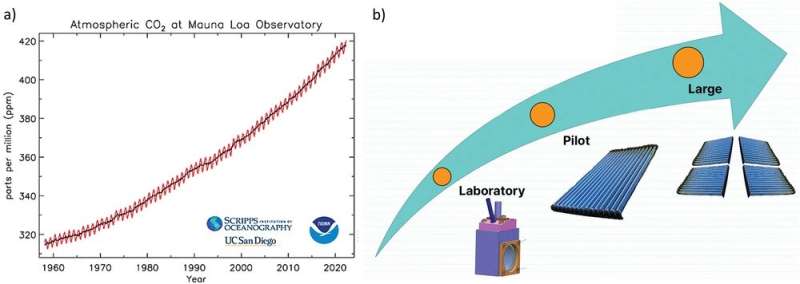
Development is at quite an advanced stage. In the Wiley publication Global Challenges, I recently presented three photocatalytic systems in that are being tested in Asia and Europe in conjunction with an international team of authors. The compact steel reactor project in France that I already mentioned is at laboratory scale and the other two projects are pilot systems.
The first system, which is currently being tested in Almeria, Spain, comprises a parabolic solar collector that uses communal wastewater to generate hydrogen. This approach is particularly interesting, since it combines generating green energy with wastewater purification.
The second pilot system was developed at the University of Tokyo. It is a panel system with 1600 catalyst units and a surface area of one hundred square meters. This concept proves that photocatalysis modules can already be used at a large scale.
Can we expect widespread use in the near future?
Unfortunately, we are not there yet. Even if the systems work and have been under stable operation for a few months, we are currently talking about efficiency levels of around one percent. This is, of course, still too low. Our aim is to achieve hydrogen production efficiency of between five and ten percent.
We need to improve the design of the reactor and optimize the process, but above all, we need more efficient catalysts. This is where materials science plays a decisive role and a considerable number of researchers are making an active contribution to progress in this area.
Where are the greatest challenges currently?
Photocatalysts have to carry out two central tasks. Firstly, they must absorb a bright spectrum of sunlight and release as many excited electrons and positive holes as possible. Unfortunately, these electron-hole pairs have a tendency to recombine.
The second step, which is the actual chemical reaction, happens on the surface. In our case, it is the interface between the catalyst and water, which is where several half reactions take place during which electrons are released and absorbed.
Current research is focusing on this interface contact between the catalysis and the reaction medium with a variety of sophisticated material strategies.
Which strategies are particularly promising?
There are some different approaches.
In a Japanese panel system, each panel has been sprayed with aluminum-doped strontium titanate, one of the most efficient photocatalysts currently available. The hydrogen separation process occurs on a membrane made of polyimide.
Our colleagues in Spain are testing a compound made of titanium oxide and nitrogen and another made of cadmium, zinc and sulfur—each in combination with platinum.
My own research is on materials based on carbon nitride that have been modified with small inorganic compounds. Antennae such as these allow the function of conventional materials to be adapted to a wide range of applications. A specific example is local doping with purpald, a sulfur precursor, which leads to a hybrid carbon nitrogen layer. Compared to pure carbon nitride, this combination has improved optical, electronic, structural and morphological properties.