locking fossil-fuel projects strikes at their ability to finance clean energy transition
Workers install a solar panel at a photovoltaic solar park on the outskirts of the coastal town of Lamberts Bay, South Africa. AP
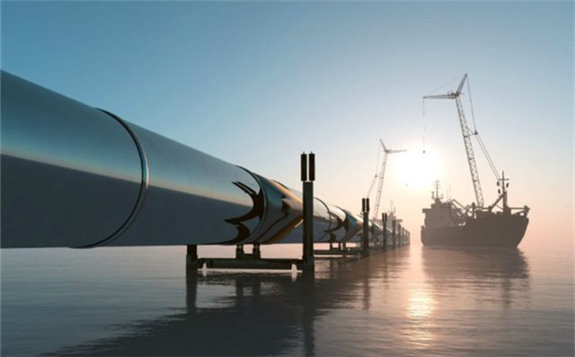
Last month, Standard Chartered said it would no longer finance the $5 billion East Africa Oil Pipeline from Uganda to the coast of Tanzania, after pressure from environmental campaigners.
Last year, the Netherlands, a small and not very sunny country, installed seven times more solar and wind power than the whole of Africa.
These two apparently unconnected facts show that the climate and energy development model for developing countries needs to be fixed quickly.
Pete Betts, a veteran British climate negotiator, who is terminally ill with cancer, recently told the Financial Times: “It’s even more important to press richer countries to provide the financing to help poorer nations shift to renewable energy. This funding is dramatically insufficient at the moment.”
Western activists and analysts like to say that Africa can “leapfrog” from energy poverty to renewables without passing through a stage of intensive fossil-fuel use. That may be true, but they are providing almost none of the finance required.
At the Cop15 climate talks in Copenhagen in 2009, developed countries committed to providing $100 billion annually for climate action in developing countries, a goal reiterated and extended to 2025 by the 2015 Paris Agreement.
The actual amount provided has increased over time, but reached just $83.3 billion in 2020, according to the Organisation for Economic Co-operation and Development.
The UN Framework Convention on Climate Change says the total might finally hit $100 billion this year — but this is overstated by double counting, considering loans as grants and ignoring inflation.
Adjusted from 2009, the amount should be more like $137 billion.
Dr Sultan Al Jaber, President-designate for Cop28, to be held in the UAE in November, said last week that developing countries are still waiting for the $100 billion promised by developed nations 14 years ago.
“At Cop28, I expect ambitious, transparent and accountable commitments from countries and businesses that will shape policies in parliaments and budgets in boardrooms.”
Even the original figure was far insufficient — developing countries need between $160 billion and $340 billion annually by 2030 just to adapt to climate change, according to the UN Environment Programme.
The International Energy Agency estimates another $30 billion per year is needed to achieve universal electricity access and $1 trillion annually for a full clean energy transition in developing and emerging economies.
Of course, developed country governments will only provide a small part of this directly. The bulk will have to come from private-sector finance, including about half from resources mobilised within developing countries themselves. The Paris Agreement financing is supposed to leverage and unlock bigger sources of capital.
The problem is that private-sector finance is far too scarce and expensive. Climate Policy Initiative, a non-profit research group, found that investors in solar power expect a 7 per cent annual return in Germany, a 10 per cent return in the UAE — but 24 per cent in Tanzania or Bolivia and 38 per cent in Zambia. Solar power costs barely 1 US cent per kilowatt hour in the UAE but more than 10 cents in Zambia — hardly better than oil and much more expensive than coal.
Developing countries struggle to finance such projects themselves, when they have many calls on limited budgets. But many of them have a large, untapped pool of funds.
Uganda’s oil would bring in about $2 billion of government revenue per year, or about 12 per cent of the country’s gross domestic product. Mozambique expects to earn $96 billion from its liquefied natural gas exports to mid-century — about a quarter of its current GDP each year.
These projects do not require home government finance — they are largely funded by international oil companies, which take the risk of “stranded assets” if future climate policy makes them unviable.
Paradoxically, blocking fossil-fuel projects in developing countries strikes at their ability to finance the clean energy transition. Climate activists will point to the International Energy Agency’s 2021 report saying that no new oil and gasfield developments would be required in a world on track for net-zero carbon.
This ignores three critical facts. First, Russia, which in 2021 was the biggest exporter of both oil and gas globally, has been virtually eliminated as a supplier to Europe, and its oil output is likely to decline much more sharply than appeared then. Europe seeks gas from African countries such as the Republic of Congo to replace Russia, while refusing to finance their own aspirations.
Second, coal-dependent countries can make quick, large savings in emissions by switching to gas.
That, in turn, is far easier and lowers carbon emissions by using local gas rather than trying to import it.
For instance, South Africa gets 70 per cent of its primary energy from coal, one of the highest shares anywhere in the world. It has recently made large gas finds off its southern coast. It would be absurd to leave these local resources in the ground in service to a global aspiration that works in a spreadsheet.
Third, there is climate logic and justice in eliminating some high-cost, high-carbon producers globally to make room for lower-carbon barrels from developing countries. Telling Kampala or Maputo not to use their own resources, while developed states are far from net-zero carbon, is climate colonialism.
The developing world needs much more green spending. A bit more from wealthy governments, within the range of political feasibility, is not enough. The pool of capital must grow while mechanisms are developed radically to lower the cost of that capital to emerging economies.
One such approach could be to tie funding of major fossil-fuel projects to recycling the resulting host-government revenue into full domestic energy access and decarbonisation, including carbon capture to eliminate emissions from these ventures.
Otherwise, commitments by commercial banks and international financial institutions not to finance fossil fuels are worse than useless, if they are not accompanied by major boosts in funding to low-carbon energy. We should not be demanding pledges of divestment but of investment.
Robin M. Mills is chief executive of Qamar Energy and author of The Myth of the Oil Crisis