Japan, an island nation that is currently heavily reliant on coal and gas power, will be carbon neutral in 2040, the country’s newly appointed prime minister Yoshihide Suga pledged in an Oct. 26 speech.
The announcement by Suga in his first major policy speech to the national Diet was not unexpected for the nation that has increasingly spearheaded notable initiatives to utilize decarbonized gas, including hydrogen and ammonia, and promote carbon capture and storage (CCS) for its sizable thermal fleet.
However, the new pledge marks a pivotal new direction for the world’s fifth-largest greenhouse gas (GHG) emitter, whose last announced major target under the Paris Agreement—submitted in June 2019—sought an 80% GHG reduction from current levels by 2050.
The Basic Energy Plan Under Revision
Japan’s previous target was based on a 2018-approved Basic Energy Plan, which anticipated renewables would account for up to 24% of its total generation mix in 2030, while fossil fuels—including coal and liquefied natural gas (LNG)—would account for 56%, and nuclear, up to 22%. But according to the Ministry of Economy, Trade, and Industry (METI), in fiscal year 2018 (which ended in March 2019), fossil fuels accounted for 77%, renewables totaled 17%, and nuclear power made up 6%.
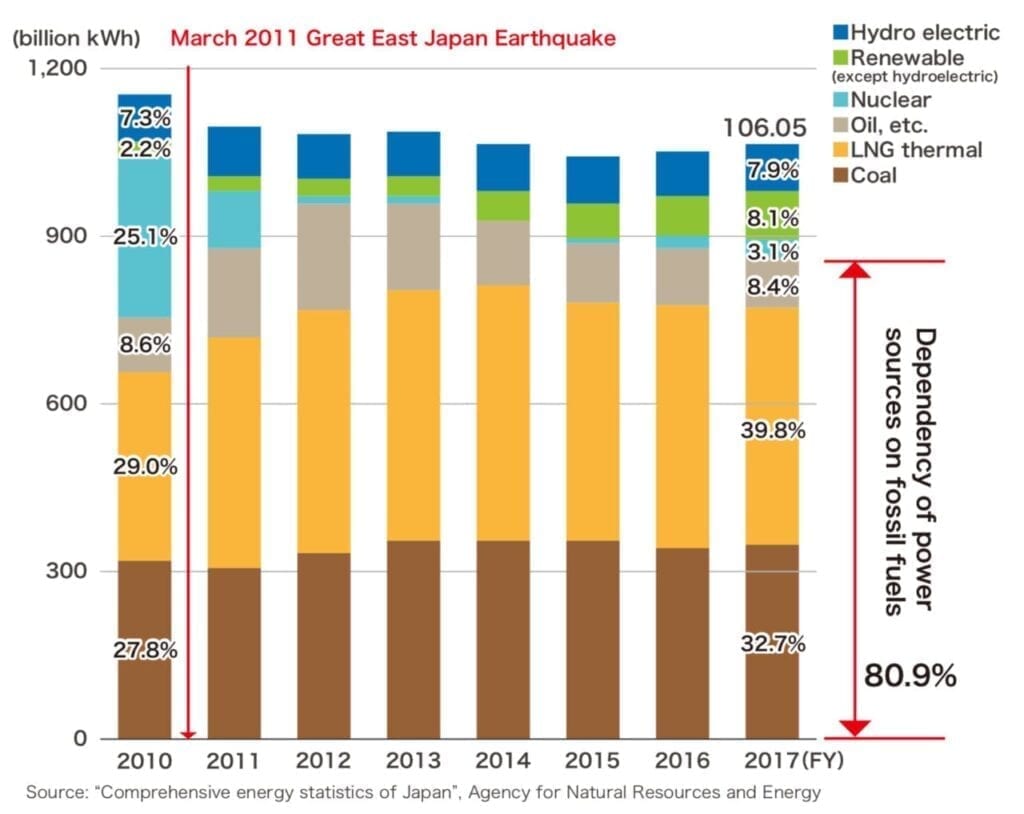
METI, notably, launched discussions earlier this month to review current targets for the nation’s 2030 energy mix as part of a periodic three-year review of its Basic Energy Plan. The current strategic Basic Energy Plan is based on the country’s long-standing “3E+S” philosophy, which prioritizes energy security, energy economics, environmental objectives, and safety.
Energy security and safety, specifically, have been key priorities for the nation since the Great East Japan Earthquake and ensuing disaster at the Fukushima Daiichi nuclear plant prompted a shutdown of all the nation’s nuclear plants for safety checks in 2011, and forced it to rely on imported coal and LNG.
Japan’s Climate Pledge Pegged to Economic Growth
Independent climate scientific analysis organization Climate Action Tracker speculated Suga’s pledge, though widely welcomed as a meaningful effort to combat global warming, was “possibly triggered by China’s 2060 carbon neutrality target announcement” on Sept. 22. On Sept. 17, the European Union (EU) also proposed a 55% cut in GHG emissions by 2030 compared to 1990 levels, a move the European Commission said would put the EU on a “balanced pathway to reaching climate neutrality by 2050.”
Japan, too, has been drifting toward climate stewardship, but it had been reluctant to commit to a stringent goal because it has “always argued that climate policy was too expensive,” Climate Tracker noted. Now, however, Suga—who served as chief cabinet secretary under Prime Minister Shinzo Abe from 2012 to 2020, before Abe abruptly resigned on Sept. 16—“is talking about growth,” the organization said in a statement to POWER.
In his speech, Suga noted, “Responding to climate change is no longer a constraint on economic growth.” He added: “Taking an aggressive approach to global warming will bring about a transformation in our industrial structure and economic system that will lead to big growth” in the economy.
As in the U.S., private sector interest in voluntary carbon initiatives is largely rooted in growing “environmental, social and governance (ESG) investment and the increasing sense of urgency on climate risks in the business sector and the government’s recent realization that coal is no longer an economic option,” Carbon Tracker said.
As of July 2020, membership in the 2016–established Electric Power Council for a Low Carbon Society (ELCS), a Japanese coalition that is committed to a low-carbon society, had grown to 62 companies. Members include J-Power and the Japan Atomic Power Co., which in 2019 accounted for 80% of Japan’s 269-GW peak output. Other notable participants include major thermal generators like JERA Co., Marubeni, Summit Energy, and Chubu Electric.
Phasing Out Inefficient Coal
But Japan’s power sector may also be reacting to recent signals by the government that support industrial decarbonization. On July 3, 2020, for example, Japan’s Minister of Economy, Trade and Industry Hiroshi Kajiyama announced that Japan would develop concrete plans to phase out inefficient coal-fired power plants. While the minister did not detail the agency’s plans, Nikkei Asia reported that 110 or the country’s 140 coal plants “are seen as inefficient.”
According to POWER‘s analysis of data curated by Beyond Coal Japan, the nation has 160 coal plants with a total capacity of 49 GW. Of these, 109 (a combined 12 GW) are subcritical plants, 20 (13 GW) are supercritical, 29 (23 GW) are ultrasupercritical, and two (416 MW) are integrated gasification combined cycle plants. The database suggests 17 new coal plants (an estimated 10 GW) are in planning, the majority (8 GW) of which are ultrasupercritical plants.
On Monday, Suga again suggested, without concrete detail, that Japan will seek to achieve carbon neutrality by 2050 via a fundamental revision of its policy on coal plants. To ensure energy security, the nation will work to introduce renewable energy “to the maximum extent” and “advance nuclear energy policies with a high priority on safety,” he said.
Additionally, the nation will also promote research and development (R&D) on second-generation solar PV technology and carbon recycling, implement digitalization in environment-related fields, and expand energy conservation, Suga said.
Though Suga did not mention it in his speech, these actions will presumably include efforts under Japan’s “Progressive Environment Innovation Strategy,” which it described in its June 2019–set Paris Targets. Among that strategy’s initiatives are to establish, by 2050, a concrete cost target for innovative technologies, such as new solar PV systems; carbon capture, utilization, and storage (CCUS); and a low-cost hydrogen supply chain (Figure 2). It will also seek to build investor confidence in “zero-emission” technologies. On Oct. 9, METI and the New Energy and Industrial Technology Development Organization (NEDO) announced 320 companies were participating in the Japan Business Federation’s “Zero-Emission Challenge,” a project that seeks to build investor confidence in innovative technologies such as hydrogen, carbon capture and utilization, and renewables.

Finally, “We will make all-out efforts, such as mobilizing all policies such as regulatory reform, promoting the further uptake of green investment, and creating a new place for consideration in the national and local governments toward the realization of a carbon-free society,” Suga said.
In a press conference following Suga’s speech, Kajiyama told reporters that plans to attain carbon neutrality by 2050 will be drawn up as part of a “growth strategy” by the end of the year. In another press conference on Oct. 27, Chief Cabinet Secretary Katsunobu Kato said the government plans to review the 2018 Basic Energy Plan before COP 26 takes place in Glasgow in November 2021.